
Capital in Crisis: Re-Evaluating the Insolvency and Bankruptcy Code’s Efficacy in Corporate Finance Post-2025 Amendments
Sejal1, Vishrut Veerendra2
1Student at National University of Study and Research in Law, Ranchi, Jharkhand, India
2Student at National University of Study and Research in Law, Ranchi, Jharkhand, India
In: The Evolving Landscape of Insolvency Law in India: Contemporary Issues and Policy Perspectives, edited by Dr. Manoj Kumar Sharma and Mr. Gyan Prakash Kesharwani
- Pages
- 141–160
- Published
- 2026
- Licence
- CC BY-NC 4.0
Abstract
The Insolvency and Bankruptcy Code, 2016 (“IBC”), was heralded as a transformative framework intended to restore creditor primacy and institutional discipline within India’s distressed asset ecosystem. However, the Code’s expanding interface with corporate finance, particularly its influence on debt structuring, capital markets, and investor confidence, has exposed persistent structural limitations. This paper critically re-evaluates the IBC’s efficacy in light of the 2025 Insolvency and Bankruptcy Board of India (“IBBI”) amendments, questioning whether the current regime adequately supports the needs of a modern, investment-driven financial system. Adopting a multi-stakeholder lens, the study analyses recent and systemically significant insolvency proceedings such as Zee Entertainment Enterprises, Indiabulls Housing Finance, and Byju’s Alpha to highlight procedural asymmetries, erosion of asset value, and the Code’s limited adaptability to asset-light and sector-specific financial stress. These cases reveal the consequences of protracted timelines, undifferentiated moratoriums, and misaligned stakeholder incentives. The paper also considers evolving jurisprudence on differential treatment of creditors, valuation disputes, and CoC commercial discretion, as seen in key appellate rulings and regulatory commentaries that continue to shape the resolution landscape. Integrating doctrinal analysis with empirical indicators drawn from SEBI disclosures, CRISIL ratings, and judicial records, the paper assesses the IBC’s impact on credit market depth, investment risk appetite, and resolution predictability. Comparative insights are drawn from the UK’s pre-pack administration model, the U.S. Chapter 11 debtor-in-possession framework, and Singapore’s creditor-class restructuring tools—each offering greater alignment with global capital standards. The paper concludes that without deeper structural reforms—including class-based voting rights, dynamic moratorium design, contingent equity protection, and sector-specific pre-packaged resolution mechanisms—the IBC risks undermining the capital formation it was designed to secure. In a financial environment increasingly shaped by institutional capital, rapid sectoral shifts, and global risk sensitivities, the Code must evolve to protect not just creditor recovery but the integrity and appeal of India’s broader investment climate.
Keywords
- Insolvency and Bankruptcy Code
- Creditor Classification
- Corporate Finance
- IBBI 2025 Amendments
- Pre-pack Resolution
- Investment Climate
Full text
1 Introduction
A nation’s insolvency regime efficiency is inextricably linked to the soundness of its financial system. Not only does it determine how capital is recovered, but also how effectively it is recycled, revalued, and redirected across industries. In India, the Insolvency and Bankruptcy Code, 2016 (“IBC”) was adopted to replace a fragmented regime with a single integrated statute for corporate resolution of distress. It was meant to rationalise resolution, enforce creditor primacy, and introduce market discipline. Almost a decade on, and in particular with the IBBI’s 2025 amendments notified on 12 March 2025, the regime is experiencing indications of structural wear.1
The 2025 reforms focused on tightening procedural timelines for the Information Memorandum, reforming the appointment of Registered Valuers, and mandating early-stage disclosure of resolution plan essentials, and represent a step forward in administrative clarity. However, these improvements remain procedural and do not confront deeper institutional limitations. The regime still lacks answers to core concerns such as creditor classification asymmetries, valuation uncertainty, and the rigidity of the moratorium architecture, all of which continue to affect investor confidence, delay recoveries, and distort capital flows.2
The challenge is not merely technical or legal; it is financial. Modern corporate finance increasingly depends on transparent, time-bound, and commercially responsive insolvency systems. The Code was constructed at a time when defaults were concentrated in capital-heavy industries—steel, infrastructure, and power. But today’s insolvency cases increasingly arise from asset-light, tech-driven, or financial-sector entities whose balance sheets are weighted toward intangibles, investor equity, or layered capital structures. In this environment, the Code’s rigid tools are insufficient.
The Byju’s Alpha case, for instance, laid bare the challenges in applying conventional resolution mechanisms to firms with investor-led cap tables, cross-border holding structures, and intangible asset profiles. Likewise, the Zee Entertainment Enterprises judgment underscored the Code’s failure to reconcile valuation thinking or moratorium design with industry business models such as media and digital streaming. In the case of Indiabulls Housing Finance, the IBC’s partial coordination with the financial-sector regulators resulted in jurisdictional ambiguity and ambiguity regarding the resolution process.
The genesis of these problems is the unilateral concentration of discretion on the Committee of Creditors (“CoC”). While commercial judgment is protected by judicial standards, the absence of regulation of intra-creditor equity has resulted in persistent judicial disputes over differential treatment of stakeholders standing in comparable shoes—most notably operational creditors and unsecured bondholders. Despite judicial interventions, the structural imbalance3 is at its heart, affecting both fairness and predictability—two essential prerequisites for creating confidence in capital markets.
This stagnation is juxtaposed with reforms enacted by comparable jurisdictions. The United Kingdom, for instance, has updated its pre-pack administration regime by the Administration (Restrictions on Disposal etc. to Connected Persons) Regulations 2021, requiring independent evaluators to undertake a stringent review of connected party sales to ensure maximum transparency and protection of value.4 This mechanism allows debtor firms to negotiate restructuring terms within an in-camera environment before formal insolvency proceedings are initiated, thereby protecting enterprise value and reducing procedural costs. The United States’ Chapter 11 regime under the Bankruptcy Code of 1978 allows for Debtor-in-Possession (“DIP”) financing, enabling firms to raise capital and retain managerial control over insolvency difficulties. In addition, the Small Business Reorganization Act of 2019, which enacted Subchapter V into Chapter 11, has streamlined procedures for small and medium-sized enterprises by eliminating creditors’ committees, establishing debt thresholds, and utilising simplified restructuring techniques.5 Such attributes enhance quicker recoveries and are under contemplation by insolvency reform commissions globally.
Notably, Singapore’s Insolvency, Restructuring and Dissolution Act of 2018 (“IRDA”), which took effect on July 30, 2020, offers a hybrid model that combines elements of the United States and United Kingdom approaches. It permits automatic moratoriums, super-priority rescue financing, and cross-class cramdowns, thereby giving courts greater flexibility to approve plans that meet the broader commercial interests of creditor classes, even where certain groups dissent.6 The IRDA was further complemented in 2022 with the introduction of the Simplified Insolvency Programme to expedite restructuring for micro and small businesses.7
India’s attempt to emulate these global trends through the Pre-Packaged Insolvency Resolution Process (“PPIRP”) in April 2021, under Chapter III-A of the IBC, was restricted to MSMEs and has seen limited uptake.8 The lack of enabling provisions for larger firms to enter pre-agreed, court-supervised restructuring has constrained the Indian system’s ability to prevent value destruction during early-stage distress. The cumulative effect of these inefficiencies is a drag on the development of the credit market. Recovery rates remain volatile, averaging 32.8% as of 2024, down from the 43% average recorded in FY20, according to IBBI performance reports.9 Institutional investors continue to express concerns over procedural unpredictability, valuation asymmetry, and the absence of creditor-class voting rights. Bondholder participation in stressed asset auctions has declined, and CRISIL’s post-resolution outlook for several large cases reflects growing scepticism over recovery certainty.10
The IBC’s original vision was to facilitate timely resolution and capital reallocation, and now requires a deeper recalibration. In an economy increasingly shaped by institutional capital, fast-changing sectoral models, and global credit sensitivities, India’s insolvency regime must evolve. Mere procedural reform is insufficient. The framework must now incorporate class-based voting, sector-specific pre-packs, contingent equity protections, and dynamic moratorium design aligned with commercial realities. Without such changes, the Code risks becoming a source of capital friction rather than a mechanism for capital resolution.
2 Theoretical Foundation: Creditor Control vs. Debtor Possession in Modern Finance
2.1 The Creditor-in-Control Paradigm: Theoretical Underpinnings
The IBC’s architectural choice of creditor control reflects the Creditors’ Bargain Theory articulated by Thomas Jackson, which treats insolvency as a collective debt-collection exercise designed to replicate the agreement creditors would have reached ex ante. This theoretical foundation posits that creditors, as the residual risk-bearers, possess superior information and incentives to maximise asset value compared to management that has already demonstrated failure. The Supreme Court’s endorsement of this approach in Innoventive Industries Ltd. v. ICICI Bank Ltd.11 crystallised India’s transition from debtor-friendly regimes to a creditor-centric framework, with the Court observing that “the erstwhile management, which is in charge of the corporate debtor, has no role to play once the corporate insolvency resolution process is initiated”.
The theoretical basis for creditor control extends beyond mere procedural efficiency to include behavioural economics considerations. The IBBI’s behavioural analysis suggests that the IBC functions as a “nudge” mechanism, creating deterrent effects that foster proactive resolution and discourage strategic defaults. The raising of the default threshold from ₹1 lakh to ₹1 crore in March 2020 acted as a behavioural intervention aimed at limiting corporate debtor opportunism while promoting early intervention.
2.2 Transaction Cost Economics and Insolvency Efficiency
Transaction Cost Economics (“TCE”) provides a crucial lens for analysing the IBC’s efficiency in modern corporate finance contexts. The Code has substantially reduced transaction costs by streamlining provisions and imposing stringent timelines, facilitating smoother negotiations between stakeholders. However, TCE analysis reveals that the IBC’s rigid, one-size-fits-all approach may generate unnecessarily high transaction costs for certain types of corporate restructuring, particularly those involving complex stakeholder hierarchies or cross-border elements.
The Coase Theorem’s application to corporate insolvency suggests that efficient bargaining between creditors and debtors can achieve optimal outcomes regardless of initial legal assignments, provided transaction costs remain low. The IBC’s framework generally supports this by reducing information asymmetries and providing clear procedural guidelines. However, the persistence of high haircuts (averaging 67% for lenders) indicates that transaction costs remain substantial, potentially due to the framework’s inflexibility in accommodating diverse business models.
2.3 Behavioural Economics and Moral Hazard Mitigation
The IBC’s deterrent effect represents one of its most significant achievements from a behavioural economics perspective. The threat of losing management control has generated voluntary settlements worth approximately ₹14 trillion across 30,000 cases—substantially exceeding direct recoveries through formal proceedings. This “shadow effect” demonstrates how insolvency law can shape behaviour even when not directly invoked, supporting theories of legal deterrence in financial markets.
However, behavioural analysis also reveals potential moral hazard concerns inherent in the creditor-control model. The concentration of decision-making power in financial creditors may create incentives for excessive risk-taking by lenders, knowing they retain control during distress situations. This contrasts with debtor-in-possession models that maintain management accountability and may better align incentives for sustainable business practices.
3 Empirical Assessment: Resolution Outcomes and Systemic Performance
3.1 Timeline and Recovery Analysis: The Persistence of Delay
The IBC’s fundamental promise of time-bound resolution has been systematically undermined by protracted proceedings that substantially exceed mandated timelines. According to IBBI data as of March 2025, the average resolution time has deteriorated to 713 days—more than double the statutory maximum of 330 days. This represents a worsening from 679 days as of March 2024, indicating that recent amendments have failed to address the underlying causes of delay.
More critically, approximately 78% of ongoing CIRP cases have exceeded the 270-day threshold (180-day base period plus 90-day extension), with many proceedings extending beyond two years. Real estate sector cases present particular challenges, with an average pendency of 2.5 years for 200 cases involving approximately ₹70,000 crores in admitted claims. This extended timeline reflects the sector’s unique challenges, including cross-collateralization, regulatory clearances, and homebuyer protection requirements that the IBC’s standard framework cannot adequately address.13
3.2 Recovery Rate Performance: Comparative Excellence Amid Structural Constraints
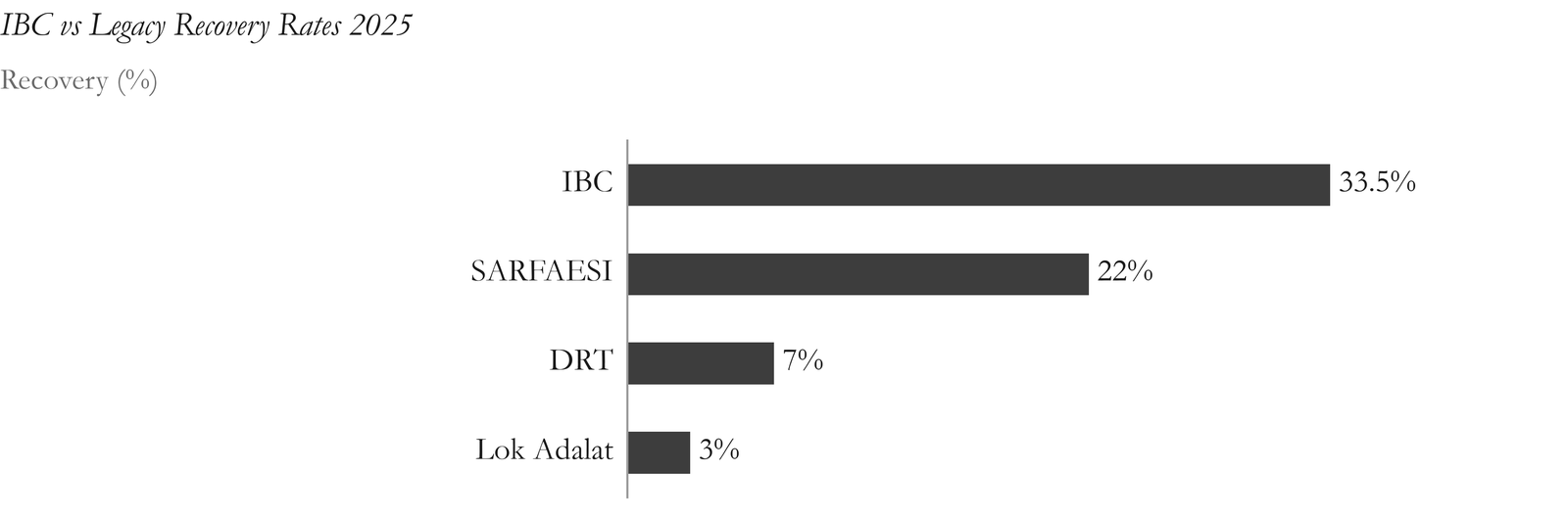
Despite timeline challenges, the IBC demonstrates superior recovery performance compared to legacy mechanisms. Current IBBI data indicate overall recovery rates of approximately 32.76% for financial creditors as of Q4 FY2025, representing an improvement from 31.39% in Q3 FY2025. These figures substantially exceed pre-IBC recovery mechanisms, which achieved approximately 26% through SARFAESI, 7% through DRT, and 3% through Lok Adalats.
The resolution-to-liquidation ratio has improved dramatically from 0.20 in FY18 to 1.89 in Q4 FY2025, with Q4 FY2025 achieving a record-high 70% realisation against admitted claims in certain cases. However, this performance is driven by improved recovery in large cases (with admitted claims exceeding ₹1,000 crores, achieving 77% recovery), while smaller cases continue to face challenges.
Financial creditors have recovered ₹67,000 crores through IBC in FY2025, marking a 42% increase from the previous year and representing the highest annual recovery since the Code’s inception. This performance reflects both improved procedural efficiency and enhanced NCLT capacity, with only three vacancies out of 63 positions as of March 2025, compared to 28 vacancies in October 2022.14
3.2.1 Sectoral Variations and Asset-Light Business Challenges
Empirical analysis reveals significant sectoral variations in resolution outcomes that reflect the IBC’s differential effectiveness across business models. Traditional manufacturing and infrastructure sectors demonstrate recovery rates closer to overall averages, while service-oriented and asset-light sectors show lower recovery rates due to value erosion during extended proceedings.
The technology sector presents particular challenges, as demonstrated by the Byju’s Alpha case, where primary value resides in intellectual property, user data, and platform functionality rather than traditional physical assets.15 The IBC’s resolution approach, designed for asset-heavy manufacturing companies, proves fundamentally inadequate16 for such entities, leading to substantial value destruction during the resolution process.
3.2.2 Investment Climate Impact: Credit Market Development and Risk Premiums
The IBC has demonstrably enhanced credit discipline through its deterrent effect, with reports indicating voluntary settlements of approximately ₹14 trillion due to promoter concerns about losing management control. This behavioural impact represents one of the Code’s most significant achievements in transforming India’s credit culture from a “defaulters’ paradise” to a creditor-protective environment.
Private credit market development provides additional evidence of improved investor confidence, with India’s private credit assets under management growing 25-fold from $0.7 billion in 2010 to $17.8 billion in 2023.17 The enactment of the IBC is cited as a key catalyst for this growth, providing statutory mechanisms for creditor protection in debt investments.
However, the persistence of high haircuts (averaging 67%) and extended resolution timelines creates risk premiums that partially offset the Code’s creditor protection benefits. The Reserve Bank of India’s Financial Stability Report (December 2024) reveals that despite the IBC’s success, stress tests project potential GNPA ratios rising to 5.3% under severe scenarios by March 2026, indicating ongoing systemic vulnerabilities.18
4 Case Studies: Structural Limitations in Complex Corporate Contexts
4.1 Zee Entertainment Enterprises: Guarantee Structures and Sectoral Complexity
The Zee Entertainment Enterprises Limited (“ZEEL”) case exemplifies the IBC’s inadequate treatment of complex guarantee structures and sector-specific business models prevalent in the media and entertainment industries. IDBI Bank initiated insolvency proceedings against ZEEL under Section 7, claiming ₹149.60 crores based on a Debt Service Reserve Account (“DSRA”) guarantee provided by ZEEL for loans extended to Siti Networks, an Essel Group entity.
The National Company Law Tribunal (“NCLT”) Mumbai initially dismissed IDBI Bank’s petition in May 2023, a decision subsequently upheld by the National Company Law Appellate Tribunal (“NCLAT”) in April 2025. However, the NCLAT granted IDBI Bank the liberty to file fresh applications for defaults occurring outside the COVID-19 moratorium period specified under Section 10A of the IBC. The tribunals’ rejection was based on technical interpretations of guarantee obligations rather than a substantive assessment of ZEEL’s financial position or the underlying commercial rationale for the guarantee structure.19
The case highlights several critical limitations: the IBC’s binary classification of financial debt fails to accommodate nuanced guarantee obligations in modern corporate structures; media companies’ substantial value from intangible assets, including content libraries and brand value, cannot be adequately valued through traditional asset-focused approaches; and the Code’s poor integration with sector-specific regulatory frameworks creates additional procedural complexities.
4.2 Indiabulls Housing Finance: NBFC Distress and Systemic Risk Implications
The insolvency proceedings initiated by Indiabulls Housing Finance Limited (IHFL) against Subhash Chandra, as a personal guarantor, illustrate the IBC’s limitations in addressing Non-Banking Financial Company (NBFC) distress and associated systemic risk implications. The NCLT Delhi’s acceptance of IHFL’s insolvency petition against Subhash Chandra in April 2024 arose from defaults by Vivek Infracon, a company associated with the Essel Group chairman.20
The case involves complex inter-group lending arrangements, multiple regulatory authorities (including SEBI, ED, and CBI), and potential criminal law implications, creating a multi-jurisdictional procedural maze. The Supreme Court’s criticism of the CBI’s non-appearance in related proceedings highlights institutional coordination challenges that arise when IBC processes intersect with criminal investigations and regulatory enforcement actions.
NBFCs operate under specific capital adequacy and liquidity requirements imposed by the Reserve Bank of India. The IBC’s standard resolution approach does not adequately address how these regulatory requirements interact with insolvency proceedings, potentially compromising financial stability. Unlike traditional manufacturing entities, NBFCs have direct customer relationships involving deposits, loans, and investment products, requiring specialised stakeholder protection mechanisms that the current framework cannot provide.
4.3 Byju’s Alpha: Cross-Border Complexity and Asset-Light Business Models
The Byju’s Alpha insolvency proceedings represent perhaps the most complex case testing the IBC’s capabilities, involving cross-border elements, sophisticated financial structures, and asset-light business models characteristic of modern technology companies. The case involves Think and Learn Private Limited (Byju’s parent company) as corporate debtor, Byju’s Alpha Inc. (a US subsidiary) as the borrowing entity, and GLAS Trust Company LLC as administrative agent for USD 1.2 billion in loan facilities.21
The Supreme Court’s decision to reinstate insolvency proceedings despite a settlement between BCCI and Riju Raveendran highlights challenges of managing cross-border asset flows and related party transactions within the IBC framework. The Court’s concern about potential “round-tripping” of funds from the US entity to settle Indian obligations reflects the Code’s inadequate mechanisms for addressing complex corporate structures spanning multiple jurisdictions.22
Byju’s represents the archetypal asset-light technology company, with primary value residing in intellectual property, user data, technology platforms, and human capital rather than traditional physical assets. The IBC’s resolution approach proves fundamentally inadequate for such entities: technology companies’ value derives primarily from intangible assets that are difficult to value and transfer; operational continuity requires specialised expertise that the framework cannot accommodate; and cross-border asset mobility undermines the Code’s moratorium provisions and creditor protection mechanisms.
4.4 Jet Airways: Implementation Failure and Liquidation
The Supreme Court’s November 2024 decision ordering the liquidation of Jet Airways (India) Limited after a five-year resolution effort underscores critical implementation challenges within the IBC framework. Despite the NCLT’s approval of the Jalan Fritsch Consortium’s resolution plan in June 2021, subsequent implementation failures led to the airline’s ultimate liquidation.
The case highlights the IBC’s inadequate mechanisms for ensuring resolution plan implementation, with the successful resolution applicant failing to fulfil conditions precedent and payment obligations despite multiple timeline extensions. The Supreme Court’s criticism of NCLT functioning and emphasis on the necessity led to subsequent regulatory amendments mandating such committees.23
5 International Comparative Analysis: Sophisticated Frameworks for Modern Finance
5.1 UK Pre-Pack Administration: Preserving Going Concern Value
The United Kingdom’s pre-pack administration framework demonstrates a sophisticated balance between speed, stakeholder protection, and value preservation that contrasts favourably with the IBC’s rigid approach. Pre-pack administration involves the pre-negotiated sale of business or assets before formal administrator appointment, preserving business continuity and going concern value while providing legal certainty.24
The framework operates under Statement of Insolvency Practice 16 (SIP 16) governance, mandating independent asset valuations, marketing evidence, and detailed creditor reporting. Licensed insolvency practitioners must demonstrate superior returns compared to alternative approaches, creating substantive accountability mechanisms often absent in IBC proceedings.25 The Pre-Pack Pool provides independent expert opinions on connected party transactions, offering additional stakeholder protection.26
Recent regulatory enhancements through the Administration (Restrictions on Disposal etc. to Connected Persons) Regulations 2021 demonstrate continued evolution, requiring independent opinions or creditor approval for substantial disposals to connected persons within eight weeks of administration.27 This level of procedural sophistication and stakeholder protection contrasts sharply with the IBC’s one-size-fits-all approach.
5.2 US Chapter 11: Debtor-in-Possession Flexibility and Stakeholder Sophistication
The United States Chapter 11 framework offers perhaps the most flexible approach to corporate reorganisation, with particular strength in accommodating complex stakeholder hierarchies and diverse business models. Chapter 11’s debtor-in-possession (DIP) mechanism allows existing management to retain operational control during reorganisation, recognising that management typically possesses specialised knowledge necessary for effective business continuation.28
Commercial Chapter 11 filings increased 20% in 2024 to 7,879 cases, demonstrating continued relevance for complex restructurings.29 The framework’s sophisticated creditor classification system accommodates multiple stakeholder categories with differentiated treatment provisions, while “cramdown” mechanisms prevent minority holdout creditors from blocking value-maximising reorganisations.
DIP financing has evolved to include increasingly sophisticated structures, with 2025 seeing facilities with interest rates exceeding 15% and complex fee arrangements, demonstrating market adaptation to diverse financing needs.30 The framework’s integration with securities regulations and accommodation of public company considerations provides essential capabilities for listed entities undergoing reorganisation.31
5.3 Singapore’s IRDA: Cross-Class Cramdown and Enhanced Judicial Innovation
Singapore’s Insolvency, Restructuring and Dissolution Act 2018 (IRDA) represents a modern synthesis of common law principles with innovative mechanisms designed for contemporary corporate finance challenges. The cross-class cramdown provisions enable restructuring plans to bind dissenting creditor classes provided procedural and substantive safeguards are met, requiring approval by at least one creditor class and overall creditor approval by a majority in number representing 75% in value.32
Recent committee recommendations propose refining cross-class cramdown threshold requirements to remove conditions requiring a majority in number of creditors representing three-fourths in value, making the mechanism more functional for contemporary restructurings.33 The framework’s ability to bind secured creditors through cramdown mechanisms, subject to appropriate safeguards, provides essential flexibility for complex restructurings involving multiple security interests.
Singapore’s adoption of enhanced cross-border capabilities through UNCITRAL Model Law integration, coupled with recognition and enforcement mechanisms, provides sophisticated capabilities for managing international insolvency proceedings essential for modern corporate restructurings.34
5.4 Germany’s StaRUG: Pre-Insolvency Framework Innovation
Germany’s Corporate Stabilisation and Restructuring Act (“StaRUG”), introduced on January 1, 2021, provides a comprehensive pre-insolvency restructuring framework that contrasts with the IBC’s limited pre-pack mechanisms. The StaRUG enables companies facing imminent illiquidity to initiate preventive restructuring proceedings while retaining management control, avoiding formal insolvency stigma.35
The framework has gained momentum, with twice as many companies utilising it in recent years compared to initial periods, including larger companies undertaking comprehensive capital structure restructurings.36 The procedure enables “partial-collective” restructuring, allowing selective creditor inclusion and financial-only restructuring, providing flexibility unavailable under traditional insolvency procedures.
However, the StaRUG’s limited international recognition compared to UK frameworks highlights the importance of cross-border integration for global corporate restructurings. The requirement for German language proceedings and limited international trust constrain its effectiveness for multinational entities.37
5.5 Canada’s CCAA: Flexibility and Third-Party Releases
Canada’s Companies’ Creditors Arrangement Act (“CCAA”) demonstrates a flexible, court-supervised approach that provides a beneficial framework for complex restructurings. The CCAA requires a minimum CDN$5 million debt threshold and provides broad stay protection for debtors, directors, and officers, with potential extension to third parties.38
The framework’s flexibility enables creative solutions benefiting all parties, with court oversight and monitor appointment providing stakeholder comfort and process transparency.39 Specialised tools like “reverse vesting orders” (RVOs) allow corporate preservation by “vesting out” unwanted liabilities without requiring creditor votes, providing distinct advantages for asset preservation.40
Q1 2025 statistics show 20 CCAA proceedings filed, demonstrating continued relevance for significant restructurings. The framework’s integration with cannabis industry restructuring (unavailable in US jurisdictions) and well-developed third-party release jurisprudence provides additional flexibility for contemporary corporate challenges.41
6 Structural Deficiencies: Core Architectural Flaws
6.1 Rigid Creditor Classification and Stakeholder Hierarchy Inadequacy
The IBC’s binary classification of creditors into financial and operational categories represents a fundamental oversimplification that fails to accommodate sophisticated stakeholder hierarchies characteristic of modern corporate finance. Contemporary corporate structures involve multiple creditor sophistication layers, including senior secured lenders, subordinated debt holders, mezzanine financiers, trade creditors, and specialised service providers that cannot be adequately differentiated within the current binary system.
The NCLAT’s acknowledgement in NCC Ltd. v. Golden Jubilee Hotels Private Limited42 that operational creditors may require sub-categorisation into “special operational creditors” based on strategic importance represents judicial recognition of the classification system’s inadequacy. However, systemic reform requires a comprehensive framework revision rather than case-by-case judicial intervention.
The concentration of decision-making authority in the Committee of Creditors (CoC), comprised exclusively of financial creditors, reflects outdated assumptions about stakeholder importance and risk allocation. Modern corporate structures often involve operational creditors whose continued participation is essential for business viability, including technology service providers, key suppliers, and intellectual property licensors.
6.2 Undifferentiated Moratorium Design and Sectoral Inflexibility
The IBC’s blanket moratorium provisions under Section 14 reflect a one-size-fits-all approach that proves counterproductive for many modern business models. Asset-light businesses in technology, financial services, and professional services require continuous client relationships, ongoing service delivery, and maintenance of professional licenses that may be compromised by blanket moratorium provisions.43
The Byju’s Alpha case exemplifies these challenges, where the company value resided in user engagement, platform functionality, and educational content delivery—all requiring continuous operational management that the IBC framework cannot adequately support. The framework’s inability to accommodate such business models represents a significant limitation in India’s increasingly service-oriented economy.
The IBC’s poor integration with sector-specific regulatory frameworks creates procedural complexities that undermine resolution efficiency. The framework lacks mechanisms for coordinating with specialised regulators like SEBI, RBI, IRDA, or sectoral authorities, leading to conflicting requirements and jurisdictional disputes demonstrated in the Zee Entertainment and Indiabulls Housing Finance cases.44
6.3 Limited Pre-Packaged Resolution and Cross-Border Integration Deficiencies
The IBC’s restriction of the PPIRP to MSMEs represents a significant limitation preventing efficient resolution of larger, complex entities. Contemporary corporate finance increasingly relies on pre-negotiated resolution arrangements that preserve stakeholder relationships, maintain operational continuity, and minimise value destruction during formal proceedings.
The framework’s limited integration with international insolvency mechanisms represents a critical limitation for India’s increasingly globalised corporate sector. The Byju’s Alpha case demonstrated how easily valuable assets can be transferred across jurisdictions, undermining the IBC’s moratorium provisions and creditor protection mechanisms. Unlike jurisdictions adopting the UNCITRAL Model Law on Cross-Border Insolvency, the IBC provides45 limited mechanisms for recognising foreign proceedings or coordinating with international restructuring efforts.46
6.4 Procedural Rigidity and Administrative Inadequacy
The IBC’s reliance on overburdened NCLTs with limited specialised expertise creates systematic procedural inefficiencies that compound structural limitations. The concentration of proceedings in tribunals creates capacity constraints directly contributing to extended resolution timelines, with significant improvement only following recent member appointments, reducing vacancies from 28 in October 2022 to three as of March 2025.47
The framework’s reliance on resolution professionals with limited specialised expertise in complex corporate finance creates information asymmetries, undermining optimal resolution outcomes.48 International frameworks demonstrate alternative approaches, including specialised commercial courts (UK), bankruptcy judges with focused expertise (US), and flexible administrative mechanisms (Singapore) that could inform IBC procedural reform.49
7 Toward Comprehensive Structural Reform: IBC 2.0 Framework
7.1 Dynamic Creditor Classification and Sophisticated Stakeholder Management
The binary financial/operational creditor classification requires replacement with a sophisticated multi-tier system that recognises creditor heterogeneity and strategic importance.50 The proposed framework would establish five primary categories: Senior Secured Financial Creditors with priority claims; Subordinated Financial Creditors, including unsecured and subordinated debt holders; Strategic Operational Creditors essential for business continuity; General Operational Creditors comprising trade creditors and non-strategic service providers; and Hybrid Creditors spanning multiple categories.
Each category would receive differentiated treatment in CoC composition, voting rights, and distribution priorities based on strategic importance and risk profile. Strategic operational creditors, essential for business continuity, should receive enhanced voting rights during resolution plan evaluation, while maintaining financial creditors’ primacy in liquidation decisions. This approach would better align decision-making authority with value creation and preservation capabilities.51
7.2 Flexible Moratorium Design and Sectoral Adaptation Mechanisms
The blanket moratorium under Section 14 requires replacement with a flexible framework distinguishing between value-destructive and value-preserving activities. Core moratorium provisions would protect against enforcement actions, asset transfers, and litigation impairing resolution prospects, while operational continuity exemptions would preserve essential contracts, regulatory licenses, and service relationships necessary for business continuity.
Sector-specific carve-outs would provide tailored exemptions for different business models, including technology platform maintenance, financial services customer obligations, and media content licensing arrangements.52 The essential services protection framework would establish statutory protection for services critical to business continuity, operating through a rebuttable presumption favouring continuity, with termination allowed only upon demonstration of material prejudice.
7.3 Universal Pre-Packaged Resolution and Enhanced Cross-Border Integration
Pre-packaged resolution mechanisms should extend beyond MSMEs to all corporate entities, with appropriate safeguards scaled to entity size and complexity. The framework should accommodate Standard Pre-Pack for straightforward cases; Enhanced Pre-Pack for larger entities with sophisticated stakeholder structures requiring additional oversight; and Cross-Border Pre-Pack for multinational entities requiring coordination with foreign proceedings.53
Drawing from UK precedents, an enhanced framework54 should mandate independent valuation by qualified professionals, marketing evidence demonstrating optimal value realisation, creditor consultation processes with meaningful participation rights, detailed post-transaction reporting and monitoring, and enhanced disclosure requirements for connected party transactions.55
India should adopt the UNCITRAL Model Law on Cross-Border Insolvency to enable effective coordination with international proceedings, complemented by bilateral cooperation agreements with major trading partners and investment source countries.56 Enhanced cross-border asset preservation mechanisms should include international cooperation protocols, asset tracing and recovery powers, and jurisdiction coordination frameworks.57
7.4 Institutional Enhancement and Professional Capability Development
The current NCLT system requires enhancement through specialised insolvency courts with dedicated judges trained in corporate finance, cross-border insolvency, and sector-specific business models. These courts should be supported by technical advisory panels providing industry expertise, enhanced case management systems, and integrated alternative dispute resolution mechanisms.58
The insolvency professional framework requires enhancement through specialised certification programs for complex cases involving cross-border elements, sector-specific knowledge, and sophisticated financial instruments. Professional liability frameworks should include enhanced liability and insurance requirements scaled to case complexity, with mandatory continuing education requirements ensuring updated professional capabilities.59
7.5 Investment Climate Integration and Capital Market Coordination
The framework should establish comprehensive coordination mechanisms with SEBI for listed entities, including streamlined disclosure requirements during insolvency proceedings, enhanced minority shareholder protection, and mechanisms for maintaining trading and market-making during proceedings.60 Institutional investment facilitation should include accommodation of complex financial instruments, enhanced foreign investment protection, and regulatory certainty mechanisms providing clear guidance on tax treatment and cross-border implications.61
8 Conclusion: The Imperative for Architectural Transformation
This comprehensive analysis reveals fundamental misalignment between the IBC’s architectural assumptions and contemporary corporate finance realities. While the Code achieved significant improvements in credit discipline and recovery rates compared to legacy mechanisms—with average recovery rates of 32-35% substantially exceeding SARFAESI (22%), DRT (7%), and Lok Adalat (3%) performance—its structural limitations systematically undermine optimal outcomes in modern financial contexts.62
The empirical evidence demonstrates persistent challenges: resolution timelines averaging 713 days against statutory 330-day maximums; value erosion estimated at ₹37,621 crores attributable to procedural delays; and sector-specific inadequacies particularly pronounced in asset-light businesses and cross-border contexts.63 The case studies of Zee Entertainment Enterprises, Indiabulls Housing Finance, and Byju’s Alpha illustrate how these limitations manifest in practice, creating procedural complexities that often undermine rather than advance the Code’s core objectives.
The 2025 IBBI amendments, while introducing incremental improvements including flexible resolution plan structures, interim finance provider participation, and mandatory monitoring committees, represent symptomatic responses rather than comprehensive solutions to underlying architectural deficiencies.64 The comparative analysis of international frameworks—particularly the UK’s sophisticated pre-pack administration, the US Chapter 11’s debtor-in-possession flexibility, Singapore’s cross-class cramdown mechanisms, Germany’s StaRUG pre-insolvency regime, and Canada’s CCAA adaptability—demonstrates that these limitations are not inevitable features of effective insolvency law but reflect specific design choices amenable to reform.
The proposed “IBC 2.0” framework addresses fundamental structural deficiencies through dynamic creditor classification, flexible moratorium design, universal pre-packaged resolution mechanisms, enhanced cross-border integration, and specialised institutional capabilities. These reforms would position India’s insolvency framework to effectively serve a sophisticated, globally-integrated economy while preserving essential creditor protections and institutional discipline.
The stakes extend beyond technical legal adjustments to encompass India’s broader economic competitiveness and investment attractiveness. In a financial environment increasingly shaped by institutional capital deployment decisions influenced by regulatory sophistication and procedural predictability, the IBC’s continued structural limitations risk constraining India’s access to international capital markets and limiting the development of sophisticated domestic financial instruments. The choice facing policymakers is not between stability and disruption, but between continued value destruction through structural inadequacy and proactive reform aligning India’s insolvency framework with contemporary corporate finance realities. The evidence supports the latter course, suggesting that costs of inaction—measured in continued value erosion, constrained capital formation, and reduced investment attractiveness—far exceed transitional costs of comprehensive structural reform.
The IBC’s evolution from its current form to an effective framework for contemporary corporate finance requires acknowledgement that the Code’s greatest strength—departure from pre-2016 institutional dysfunction—must be complemented by continued adaptation to serve India’s economic development objectives in an increasingly complex global financial system. The proposed reforms provide a roadmap for this essential evolution, offering the prospect of an insolvency regime that truly serves modern corporate finance needs while preserving institutional discipline essential for sustainable economic growth.
Notes
Insolvency and Bankruptcy Code (Amendment) Act, 2025, Statement of Objects and Reasons, at 2. ↩
Insolvency and Bankruptcy Board of India (Amendment) Regulations, 2025 (Mar. 12, 2025). ↩
Jaypee Infratech Ltd. v. NBCC (India) Ltd., 2021 SCC OnLine SC 253. ↩
The Administration (Restrictions on Disposal etc. to Connected Persons) Regulations 2021, SI 2021/427 (UK). ↩
U.S. Bankruptcy Code, 11 U.S.C. §§ 1181–1195 (Subchapter V under Chapter 11), introduced by the Small Business Reorganization Act, 2019. ↩
Insolvency, Restructuring and Dissolution Act 2018 (Sing.), Commencement Notification No. S 578/2020 (July 30, 2020). ↩
Ministry of Law, Singapore, Simplified Insolvency Programme (2022), https://www.mlaw.gov.sg. ↩
Insolvency and Bankruptcy Board of India (Pre-Packaged Insolvency Resolution Process) Regulations, 2021, reg. 14, Gazette of India, at 6 (Apr. 9, 2021). ↩
IBBI Quarterly Newsletter, vol. 30 (Q3 FY2024). ↩
CRISIL Ratings, Resolution Outcomes and Post-IBC Financial Ratings: 2018–2024 Trends (June 2024). ↩
Innoventive Indus. Ltd. v. ICICI Bank Ltd., (2018) 1 SCC 407, 420. ↩
Insolvency & Bankruptcy Bd. of India, Annual Report 2023–2024 41 (Mar. 2024), https://ibbi.gov.in/uploads/publication/de2f17cca103664da3f2c845fef35505.pdf. ↩
Insolvency & Bankruptcy Bd. of India, Quarterly Newsletter 12 (Jan.–Mar. 2025), https://ibbi.gov.in/uploads/publication/912e97d4d9f96651386541fb7059203b.pdf. ↩
Id. at 15–17. ↩
Indranil Sarkar & Arpan Chaturvedi, Once India’s Biggest Startup, Byju’s Faces Insolvency Proceedings, Reuters (July 16, 2024) (highlighting challenges of resolving companies with intangible-heavy business models under IBC). ↩
ANI, Corporate Insolvency Cases Fall 28% to 724 in FY2025; Recoveries Still Low: ICRA, Tribune India (May 28, 2025) (reporting that average resolution time increased from 679 days as of March 31, 2024, to 713 days by March 31, 2025, exceeding the IBC statutory limit, and noting a resolution-to-liquidation ratio of 1.9 in Q4 FY2025). ↩
Vivriti Asset Mgmt., Private Credit Market in India – A Deeper Look (Oct. 30, 2024) (noting private credit AUM grew from US $0.7 bn in 2010 to US $17.8 bn by 2023). ↩
Reserve Bank of India, Financial Stability Report (Dec. 30, 2024) (projecting GNPA ratios rising to 5.3% under severe scenarios by March 2026). ↩
IDBI Bank Ltd. v. Zee Ent. Enters. Ltd., Company Appeal (AT) (Insolvency) No. 587 of 2023, at 12, ¶ 13 (NCLAT Apr. 2025). ↩
Indiabulls Hous. Fin. Ltd. v. Subhash Chandra, C.P. (IB) No. 97/ND/2022 (NCLT Delhi). ↩
Glas Trust Co. LLC v. Byju Raveendran, 2024 SCC OnLine SC 4064. ↩
Riju Ravindran Suspended Director & Promoter of Think & Learn Pvt. Ltd. v. Pankaj Srivastava, IRP of Think & Learn Pvt. Ltd., MANU/NL/0311/2025 (NCLAT Apr. 17, 2025). ↩
State Bank of India v. Consortium of Murari Lal Jalan & Florian Fritsch, MANU/SC/0054/2024 (SC Jan. 18, 2024). ↩
See generally Insolvency Act 1986, c. 45, sch. B1 (UK) (on pre-pack administration). ↩
Insolvency Practitioners Ass’n (UK), Statement of Insolvency Practice 16 (SIP 16) §§ 6–9 (effective Nov. 1, 2015), https://www.insolvency-practitioners.org.uk/regulation-and-guidance/sips (last visited July 28, 2025). ↩
The Pre-Pack Pool Ltd., https://www.prepackpool.co.uk/ (last visited July 28, 2025). ↩
Administration (Restrictions on Disposal etc. to Connected Persons) Regulations 2021, SI 2021/427 (UK). ↩
11 U.S.C. §§ 1101–1174 (2018) (Chapter 11 reorganization provisions of the U.S. Bankruptcy Code). ↩
Admin. Office of the U.S. Courts, Judicial Business 2024: U.S. Bankruptcy Courts – Business and Non-Business Cases Filed, by Chapter tbl. F-2 (2025), https://www.uscourts.gov/statistics-reports/judicial-business-2024 (last visited July 28, 2025). ↩
Harvey R. Miller & Shai Y. Waisman, Is Chapter 11 Bankrupt?, 47 B.C. L. Rev. 129, 139–42 (2005). ↩
U.S. Sec. & Exch. Comm’n, Reorganization Under Chapter 11, https://www.sec.gov/reportspubs/investor-publications/investorpubsreorghtm.html (last visited July 28, 2025). ↩
Insolvency, Restructuring and Dissolution Act 2018, No. 40, § 70 (Sing.) (cross-class cramdown provisions), https://sso.agc.gov.sg/Act/IRDA2018. ↩
Ministry of Law Singapore, Report of the Committee to Enhance Singapore’s Corporate Restructuring and Insolvency Regime Recommendation 2.1 (2025), https://www.mlaw.gov.sg/files/RI_Committee_Report__11Mar2025_.pdf (last visited Sept. 29, 2026). ↩
Insolvency, Restructuring and Dissolution Act 2018, No. 40, §§ 246–250 (Sing.) (adoption of UNCITRAL Model Law); see also UNCITRAL, Model Law on Cross-Border Insolvency, U.N. Doc. A/52/17, annex I (1997), https://uncitral.un.org/en/texts/insolvency/modellaw/cross-border_insolvency. ↩
Gesetz über den Stabilisierungs- und Restrukturierungsrahmen für Unternehmen [StaRUG] [Corporate Stabilisation and Restructuring Act], Dec. 22, 2020, BGBl I at 3256 (Ger.), English translation available at https://www.bmj.de/EN/Ministry/Legislation/StaRUG.html (last visited July 28, 2025). ↩
Philipp Kessler & Arvid Herrmann, The Rise of StaRUG: Trends in German Preventive Restructuring, INSOL Europe News, Mar. 2024, at 3–5, https://www.insol-europe.org (last visited July 28, 2025). ↩
Christoph Paulus, Cross-Border Issues in Preventive Restructuring: Limitations of StaRUG, 2023 J. Int’l Insolvency L. 112, 118–20 (Ger.). ↩
Companies’ Creditors Arrangement Act, R.S.C. 1985, c. C-36, §§ 3(1), 11 (Can.), https://laws-lois.justice.gc.ca/eng/acts/C-36/ (last visited July 28, 2025). ↩
Janis P. Sarra, Restructuring Under the CCAA: Stakeholder Strategies and Judicial Discretion, 53 Osgoode Hall L.J. 445, 450–53 (2016). ↩
See Ernst & Young Inc. v. Comark Holdings Inc., 2021 ONSC 1334, ¶¶ 34–40 (Can. Ont. Sup. Ct. J.) (approving RVO structure); see also Janis P. Sarra, Third-Party Releases in Canadian Restructurings, 2023 J. Bus. L. 98, 102–05. ↩
Office of the Superintendent of Bankruptcy Canada, Insolvency Statistics in Canada – Q1 2025, tbl. 4, https://www.ic.gc.ca/eic/site/bsf-osb.nsf/eng/home (last visited July 28, 2025). ↩
NCC Ltd. v. Golden Jubilee Hotels (P) Ltd., Company Appeal (AT) (Insolvency) No. 63 of 2021, at 8, ¶ 10 (NCLAT). ↩
Insolvency and Bankruptcy Code, 2016, § 14, https://ibbi.gov.in/legal-framework/act. ↩
Zee Ent. Enters. Ltd., C.P. (IB) No. 107 of 2023 (NCLT Mumbai);
Indiabulls Hous. Fin. Ltd. v. Subhash Chandra, C.P. (IB) No. 97/ND/2022 (NCLT Delhi); see also Supreme Court Criticises Regulatory Overlap in Zee, Indiabulls Cases, LiveLaw (May 2025), https://livelaw.in. ↩
IBBI, Discussion Paper on Cross-Border Insolvency Framework in India (June 2022), https://ibbi.gov.in/uploads/whatsnew/crossborder2022.pdf (last visited July 28, 2025). ↩
UNCITRAL, Model Law on Cross-Border Insolvency with Guide to Enactment, U.N. Doc. A/52/17, annex I (1997), https://uncitral.un.org/en/texts/insolvency/modellaw/cross-border_insolvency; see also Ministry of Corp. Aff., Cross-Border Insolvency Framework for India – Draft Bill (2021), https://mca.gov.in (last visited July 28, 2025). ↩
Ministry of Corp. Aff., Parliamentary Reply on NCLT Vacancies and Appointments, Lok Sabha Unstarred Question No. 2453 (answered Mar. 2025), https://loksabha.nic.in (last visited July 28, 2025). ↩
IBBI, Annual Report 2023–2024 (noting training status and qualifications of resolution professionals), https://ibbi.gov.in/uploads/publication/de2f17cca103664da3f2c845fef35505.pdf (last visited Sept. 29, 2026). ↩
See Insolvency Act 1986, c. 45, § 393 (UK) (UK commercial courts’ jurisdiction over corporate restructuring); 28 U.S.C. § 157(b) (2018) (US bankruptcy court jurisdiction); Insolvency, Restructuring and Dissolution Act 2018, No. 40, §§ 43–47 (Sing.) (Singapore’s administrative oversight framework for RPs). ↩
See Insolvency and Bankruptcy Code, 2016, § 5(7)–(8). ↩
See Insolvency and Bankruptcy Code, 2016; see also Vinod Kothari & Reshmi Khurana, Rethinking Creditor Classes: The Case for Functional Differentiation, 14 Insolv. & Res. J. 78, 83–86 (2023). ↩
See IBBI, Expert Committee Report on Sector-Specific Moratorium Flexibility 21–24 (2023), https://ibbi.gov.in/uploads/publications/moratorium_reform_committee.pdf [https://perma.cc/Q5TA-VX42]. ↩
See Bhatt & Joshi Associates, Pre-Pack Insolvency for MSMEs: Legal Loopholes in Speedy Resolution, Bhattandjoshiassociates.com (June 2022). ↩
See Joint Insolvency Comm., Statement of Insolvency Practice 16 (SIP 16) (Apr. 2021). ↩
Yasir D. Pathan, Pre-Packaged Insolvency Resolution in India: A Comprehensive Analysis of PPIRP Under the IBC, IBC Laws (2022), https://ibclaw.in/pre-packaged-insolvency-resolution-in-india-a-comprehensive-analysis-of-ppirp-under-the-ibc-by-yasir-d-pathan/. ↩
See The Legal School, Cross-Border Insolvency in India – Adoption of the UNCITRAL Model Law, TheLegalSchool.in (2023), https://thelegalschool.in/blog/cross-border-insolvency; Insolvency and Bankruptcy Code, §§ 234–235. ↩
See Anshuman Gupta & Hunaynah Shaikh, Breaking Borders: Crafting a Robust Cross-Border Insolvency Framework for India Through Global Insights, Legal 500 (Feb. 21, 2025), https://www.legal500.com/developments/thought-leadership/breaking-borders-crafting-a-robust-cross-border-insolvency-framework-for-india-through-global-insights/; see also Shubhamkar Bhandari, Insolvency Globalization: India’s Adoption of the UNCITRAL Model Law, Mondaq (May 9, 2025), https://www.mondaq.com/india/insolvencybankruptcy/1622318/insolvency-globalization-indias-adoption-of-the-uncitral-model-law. ↩
See The Evolution of Insolvency and Bankruptcy Law in India: Recommendations include “increase the number of NCLT benches and introduce dedicated insolvency courts” with sector-specific technical support and improved case management capabilities (ssrn 2024). ↩
See IBBI (Insolvency Professionals) Regulations, 2016, reg. 5(2)(ba) (amended 2022), requiring mandatory continuing professional education for Insolvency Professionals; Guidelines on Continuing Professional Education (2019) mandate minimum credit hours; see also Taxmann Guide to IPA (2024) for post-registration certification and training requirements for complex insolvency cases. ↩
See Securities and Exchange Board of India, Framework for Protection of Interest of Public Equity Shareholders in Case of Listed Companies Undergoing CIRP Under the Insolvency and Bankruptcy Code (Consultative Paper, Nov. 10, 2022), proposing open-offer and public-shareholding conditions, enhanced disclosures, and exchange-based mechanisms to preserve trading liquidity during insolvency. ↩
See Economic Laws Practice and SEBI consultative analyses (Nov. 2022), proposing institutional investor participation, accommodation of complex securities, and maintaining regulatory clarity on post-CIRP shareholding and taxation implications for foreign investors. ↩
CRISIL and Business Standard report that IBC has resolved ₹26 lakh crore in debt over nine years, with an average recovery rate of 30–35%, compared to ~22% under SARFAESI, ~7% under DRT, and ~3% under Lok Adalat. Recovery timelines now average 713 days, well above the 330-day benchmark. ↩
The average resolution timeline of 713 days significantly exceeds the statutory limit, contributing to value erosion estimated in tens of thousands of crores. ↩
The Fourth Amendment to CIRP Regulations, effective May 26, 2025, introduces key reforms: flexible asset-wise resolution plans, participation of interim finance providers as observers in CoC meetings, mandatory reporting via monitoring committees, and structured payment hierarchy prioritizing dissenting financial creditors. ↩
Cite this chapter
Rights and permissions
Open accessThis chapter is published under the Creative Commons Attribution-NonCommercial 4.0 International licence, which permits use and sharing with appropriate credit to the authors and the source, within the terms of that licence.