
Blurring the Line between Guardians and Agents: The Fading Independence of Resolution Professionals in India’s Insolvency Framework
Sakshi Singh1, Dr. Trupti Rathi2
1Student at Symbiosis Law School, Pune, Maharashtra, India
2Assistant Professor at NICMAR University, Pune, Maharashtra, India
In: The Evolving Landscape of Insolvency Law in India: Contemporary Issues and Policy Perspectives, edited by Dr. Manoj Kumar Sharma and Mr. Gyan Prakash Kesharwani
- Pages
- 261–293
- Published
- 2026
- Licence
- CC BY-NC 4.0
Abstract
With the increasing reliance on the Insolvency and Bankruptcy Code (“Code”), concerns regarding its transparent and equitable functioning have become critical. Recently, cases report an emerging trend of collusion between Resolution Professionals (RPs), Financial Creditors (FCs), and Corporate Debtors (CDs), systematically undermining Operational Creditors’ (OCs) rights. FCs often misuse their commercial wisdom to push resolution plans that disproportionately benefit them, allegedly aided by IRP/RP. This includes facilitating suboptimal plans and making incomplete disclosures of OC claims in the Information Memorandum, with such claims extinguished once the FC gains control of the CD and invokes the Clean Slate Theory under Section 32A. These actions breach the RP’s statutory duty to act fairly and transparently, violating OCs’ rights under Sections 30(2) and 53 of the Code, and Articles 14, 19(1)(g), and 300A of the Constitution.
The authors critically analyse such collusion and its impact. Through empirical research with industry practitioners, the paper confirms growing concern around these practices. To address this, it proposes shifting from a reactive CIRP framework to proactive, rights-protective alternatives, such as structured pre-insolvency hybrid mediation, court-regulated arbitration, and rescue financing supported by super-priority debt classification. Amendments to Section 53 and RP disqualification norms are also recommended to ensure independence and fairness.
Keywords
- Pre-insolvency arbitration
- Pre-insolvency mediation
- Collusion
- Operational Creditors
Full text
1 Research Objective
- 1.To critically investigate the growing trend of collusion between RP, FCs, and the CD by examining existing market practices and identifying systemic loopholes within the Indian insolvency framework.
- 2.To assess the legal and constitutional implications of such collusion on the rights of operational creditors, with reference to Section 30(2) read with Section 53 of the Code, and Articles 19(1)(g), 21, and 300A of the Constitution.
- 3.To analyse the broad powers vested in the IRP and RP and the preferential treatment accorded to FCs under the Code, which contribute to procedural imbalance and the marginalization of operational creditors.
- 4.To propose a robust set of alternatives to the current corporate insolvency resolution process, including a pre-insolvency hybrid mediation model, a court-regulated arbitration mechanism, and a court-supervised rescue financing framework supported by a super-priority debt classification, along with recommendations for amendments to Section 53 of the Code and introducing additional disqualification criteria to ensure the independence and accountability of the IRP and RP.
2 Research Questions
- 1.Does the current insolvency legal framework provide scope for collusion between the RP, FC and the CD?
- 2.How does collusion between the RP, FC and the CD undermine the objectives, aims and novelty of the Code?
- 3.Does the wide discretionary power vested in the IRP/RP and the preferential treatment accorded to the FCs override the constitutional and statutory rights of the OC?
- 4.Can an alternative pre-insolvency in personam mechanism provide a more effective forum for the OC to advocate for their rights and financial interests?
3 Methodology
This research will involve the Doctrinal and Non-Doctrinal research.
3.1 Doctrinal Research
- a)The researcher will collect data relating to the unlawful collusive working of IRP/RPs, preferential treatment to FCs, and the violation of legal, constitutional and fundamental rights of OCs in India. Thereby suggesting amendment to the Code in view of insolvency regime in US and Singapore and the recent IBBI discussion paper on mediation by the OCs. The data will include primary and secondary data from the library based sources, books, journals, articles, judgments, case laws.
- b)Thereafter the researcher will critically analyse the laws, rules, regulations related to interests and rights of the OC violated by trending collusion between RP, FC and CD.
- c)Researcher will review the primary and secondary data, articles, journals, books which are related to the Code.
- d)The researcher will also study the various insolvency systems adopted in Singapore, the UK and the US including pre-insolvency hybrid mediation mechanism, a court regulated arbitration procedure, a court supervised rescue financing and super-priority model etc.
- e)Researcher will evaluate the various Committee reports such as Justice V.B. Eradi report, Dr. J.J. Irani Committee report, Insolvency Law Committee (ILC) report on cross-border insolvency arbitration, National Seminar for Presiding Officers of Debt Recovery Tribunal (DRT), SE-27, Programme Report and IBBI discussion paper on mediation by OC, IBBI expert committee report on framework for use of mediation under the Code 2016.
- f)Researcher will scrutinize the legislative framework of Insolvency regime of the US, the UK and Singapore.
3.2 Non-Doctrinal Research
- a)The researcher will conduct the empirical study in the Section 30(2) read with Section 53, along with Sections 32A, 29, 17, 18, 19, 20, and 25 of the Code, as well as the Regulation 3 of the IBBI (Insolvency Resolution Process for Corporate Persons) Regulations 2016. Researcher will collect the data through questionnaire method for these sections.
- b)Questionnaire will be circulated to the maximum companies pan India during the year of 2024 to seek the opinion and information regarding its implementation in context of Collusion between RP, FC and CD and discussion would be allowed from various stakeholders via G-form with various stakeholders of IBC including Insolvency Professionals, IRP/RPs, FC, CDs, OCs, Company Secretary, Company Accountant, Company lawyers, Advocates, Students and Law Professors.
Method: In present research the researcher would rely on sampling method of data collection for collection of empirical data. In sampling method the research is intending to apply non-random stratified sampling method. In stratified sampling the researcher would rely on dis-proportionate sampling method. The researcher will use Morgan Table to determine the size of sample.
Tools: The research will rely on questionnaire as a tool of data collection while collecting empirical data.
Rules of citation: The research would rely on Blue Book of Rules of Citation 21st Edition (2020).
4 Introduction
4.1 Is the Novelty of the Indian Insolvency Intact or Eroding?
In 2016, the Code was enacted as umbrella legislation governing India’s insolvency and bankruptcy framework.1 By its introduction, the regime shifted from debtor-centric to a creditor-centric approach, aligning more closely with its objective of addressing creditors’ concerns. Drafted on the recommendations of the Bankruptcy Law Reforms Committee (chaired by Dr. T.K. Viswanathan), the Code sought to replace earlier mechanisms with a market-driven, predictable, time-bound and incentive-compatible process for resolving corporate distress.2 Beyond promoting value maximisation, it aims to ensure the availability of credit and balance the interests of all stakeholders; a prioritisation that is fundamental and unavoidable.3
However, the effectiveness of the Code has declined over time due to emerging systematic inefficiencies. In FY 2023–24, the average “haircut” sustained by creditors reached an alarming 73%, with financial creditors recovering merely 32% of their admitted claims. Of the approximately 4,700 cases resolved by the first quarter of FY 2023–24, only 15% culminated in successful resolution, while nearly 45% resulted in liquidation.4 Furthermore, delays in the resolution process have worsened significantly, with the average duration escalating to 630 days, almost double the prescribed 330-day limit under the Code. Aggregate recoveries remain modest, amounting to merely ₹2.67 lakh crore, reflecting a recovery rate of just 32.6% against total admitted claims of ₹8.18 lakh crore.5 This underwhelming performance is largely attributable to protracted litigation. However, this paper argues, based on empirical and secondary research, that the increasing inefficiency of the Code may also be attributed to the rising trend of collusion between RPs and FCs.
Under Chapter I, the Code distinguishes between two types of creditors: FCs and OCs. As paragraph 5.2.1 of the Bankruptcy Law Reforms Committee Report states, FCs are individuals or entities whose connection to the organization is solely based on a financial agreement, like a loan or debt instrument. OCs, on the other hand, are those whose claims against the entity arise from operational transactions. In recognition6 of broader economic interests and public policy considerations, the Code grants FCs preferential treatment, relegating OCs to a subordinate position. While this hierarchy may serve the public good, the expansive powers conferred on FCs acting through the CoC in determining the fate of OCs raise serious concerns.
The Resolution Professional, a statutory officer appointed to oversee insolvency proceedings, wields significant authority at every stage of the process. While the Code relies on the commercial wisdom of the CoC and presumes the RP will act fairly and transparently, recent cases and reports suggest that the RP’s independence may be compromised through collusion with FCs. This veneer of FC-driven commercial wisdom has, in effect, concealed practices that adversely impact OCs, many of whom depend on continued business relationships yet often recover nothing upon liquidation.
This paper critically examines the Code itself, IBBI Circular No. IP/005/20187 read with Regulation 38(1) of the CIRP Regulations, 20168 (which prescribes the RP’s disqualification criteria), and prevailing industry practices. It demonstrates how misplaced reliance on the CoC and the RP has, in certain instances, been exploited for commercial gain, undermining the rights and legitimate interests of OCs.
5 Case Study
In a significant ruling, the Madras High Court in National Sewing Thread Co. Ltd. v. TANGEDCO9 directly addressed an increasingly subtle but dangerous practice in insolvency, collusion between the RP, FC, and the CD and its repercussions on OCs. The case concerned the petitioner, an MSME undergoing insolvency proceedings.10 As an MSME, the petitioner submitted a resolution plan under Section 240A,11 which was subsequently approved by the AA. However, the plan was skewed: the FC received partial repayment of their claimed debts while OCs were offered a mere 1% of their admitted claims, far below their liquidation value.
Later, the Resolution Applicant (“RA”) relied on the Clean Slate Theory (“CST”) under Section 32A12 to deny pre-CIRP statutory electricity dues payable for a period of 3 years owed to TANGEDCO, contending that such dues stood extinguished post plan approval by the AA, provided such claims were not included in the plan. The Court sharply analyzed whether the RP and FC acted in collusion to sideline OCs’ rights, and whether Section 32A was being misused as a shield to promote mala fide plans.
The Court ruled that the commercial wisdom of the CoC under Section 30(4)13 is not supreme. The CoC’s approved plan must still pass judicial muster under Section 31.14 A qualifier to Section 31 is Section 30(2) Explanation 1,15 which mandates that OCs cannot be treated less favorably in plans than in liquidation under Section 5316, a substantive statutory right of OCs.
The exclusion of genuine OC claims from the resolution plan impacts their fundamental right to property under Article 300A17, right to trade under Article 19(1)(g), and right to livelihood of promoters and employees of the OC under Article 21. The Court noted that the Information Memorandum (“IM”) prepared under Section 1818 by the IRP/RP forms the bedrock of claim admission, and its manipulation or selective disclosures can lead to unconstitutional extinguishment of claims post-resolution through Section 32A.19
It held that IRP’s and RP’s statutory roles under Sections 18 and 25 are not merely administrative but fiduciary and constitutional in nature. Transparency and fair representation of OC claims are core obligations of the IRP and RP. The judgment also dismissed the myth of a fiduciary hierarchy between FCs and OCs, noting both stand equally as stakeholders of the CD’s assets. The Court while ruling against the exploitation of Section 32A by the RA warned that allowing collusion between RP, FC, and CD undermines the IBC’s objective of equitable resolution and violates statutory safeguards and constitutional guarantees, especially for OCs. In yet another case, the Supreme Court in Independent Sugar Corporation Ltd. v. Girish Sriram Juneja & Ors.20 emphasized the mandatory nature of obtaining prior approval from the Competition Commission of India (CCI) where a resolution plan amounts to a combination under Section 5 of the Competition Act21, in line with Section 31(4) of the IBC. In the present case, the resolution plan of AGI Greenpac, the successful resolution applicant, had no such approval at the time it was placed before the CoC; the appeal was brought by INSCO, a competing resolution applicant.
The Court categorically held that prior CCI approval is a statutory prerequisite, not a procedural formality, wherever the plan involves a combination. It further held that the RP had no power to relax this requirement, as the RP had sought to do in its communication to the resolution applicants. The Court reinforced that the RP is not a mere facilitator, but a statutory officer bound to remain fair and transparent throughout the process. The judgment reinforced that the burden of compliance with such preconditions lies with the RP, and procedural misconduct would breach mandatory statutory safeguards.
In a similar instance, the insolvency proceedings of GLAS Trust Company LLC v. BYJU Raveendran & Ors.22 garnered significant public attention when the founder of Byju’s, through a LinkedIn post, alleged collusion between the RP and the FC. While the matter was ultimately adjudicated by the SC, the ruling of the NCLT holds greater relevance for the present research. The NCLT observed that the conduct of the RP was prejudicial to the interests of stakeholders and the CIRP, particularly in light of his decision to exclude Aditya Birla Finance Ltd and Glas Trust LLC from the CoC, despite their combined voting share amounting to 99.82%. The tribunal, recognising the impropriety, reinstated the excluded creditor and simultaneously directed the initiation of disciplinary proceedings against the IRP for misleading the adjudicatory process and misusing his powers. Further, the NCLT directed the IBBI to conduct an investigation into the actions of the IRP.
6 Loopholes Identified
- 1.Are FCs misusing their commercial wisdom to push resolution plans that suppress legitimate claims of OCs, possibly in collusion with the RP?
- 2.Are the IRP and RP exploiting their powers under Sections 18 and 25 by making selective or incomplete disclosures of OC claims in the IM, thereby allowing FCs to later extinguish these claims by invoking the CST under Section 32A?
- 3.Can the potential collusion between the RP, FC, and CD be traced to the fact that FCs can suggest the RP under Section 7, and Regulation 3 fails to lay down adequate safeguards to ensure the RP’s independence from creditors and the CD?
- 4.Does the Code’s preferential treatment of FCs enable collusion and weaken the position of OCs, who lack an effective platform to assert their claims on an equal footing?
7 Empirical Study: Collusion between RP, FC and the CD during CIRP
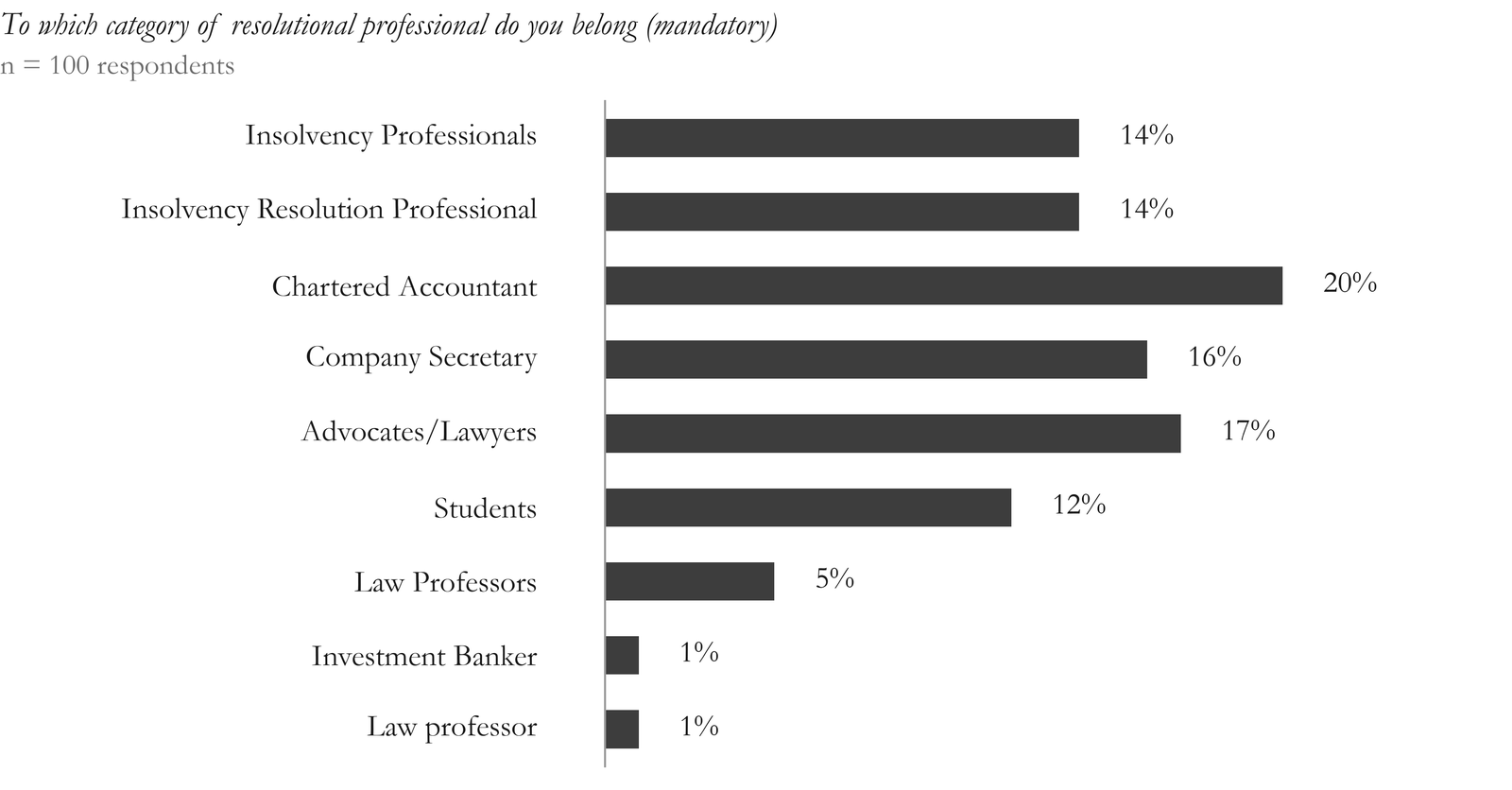
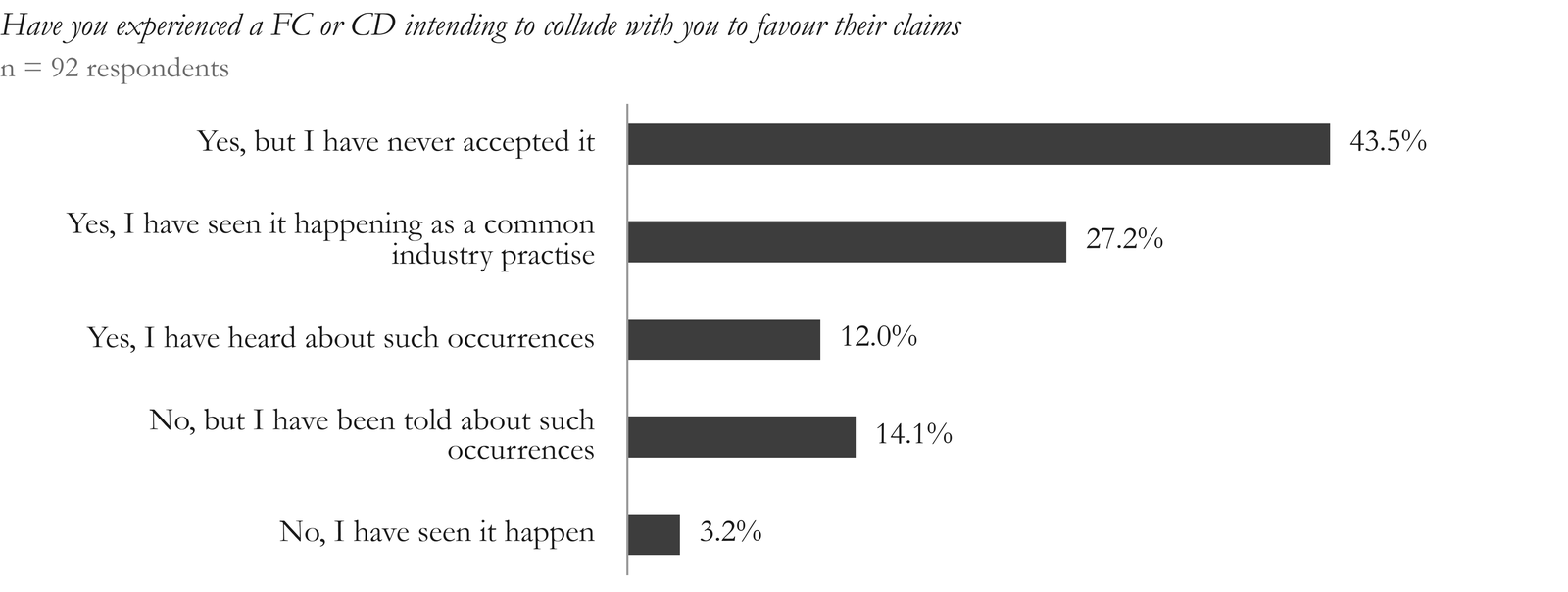
To understand the existence and awareness of collusion between the RP, FC and the CD, the authors conducted an empirical study based on 100 responses (Fig.1). The research sample consisted of IPs, IRPs/RPs (including liquidators/administrators in the pre-2016 regime), CAs, CS, advocates, lawyers, law professors, students, and investment bankers (Fig. 1).
8 Data Finding
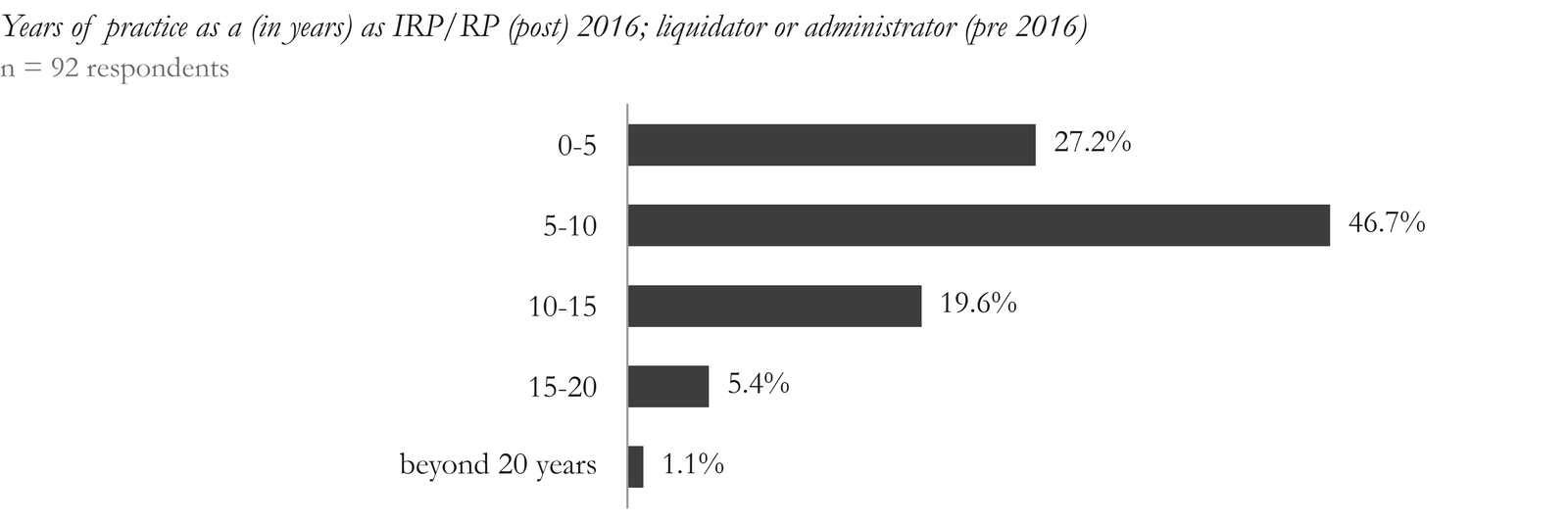
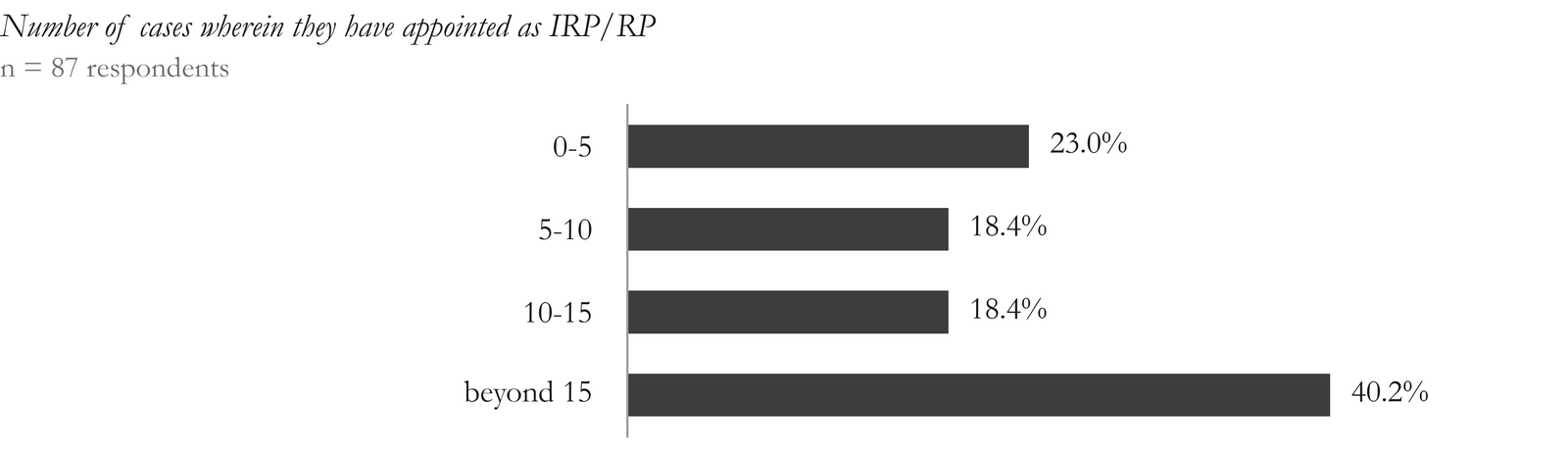
- 1.Notably, 67% of respondents (Fig. 1) are CAs, CS, advocates/lawyers, and IRPs. A majority, 66.3% of respondents (Fig. 2) have an industry experience of 5-15 years as IRPs/RPs (post-2016) and as liquidators/administrators (pre-2016), with 40.2% of these practitioners having handled more than 15 insolvency disputes at the time of filling the form (Fig. 3).
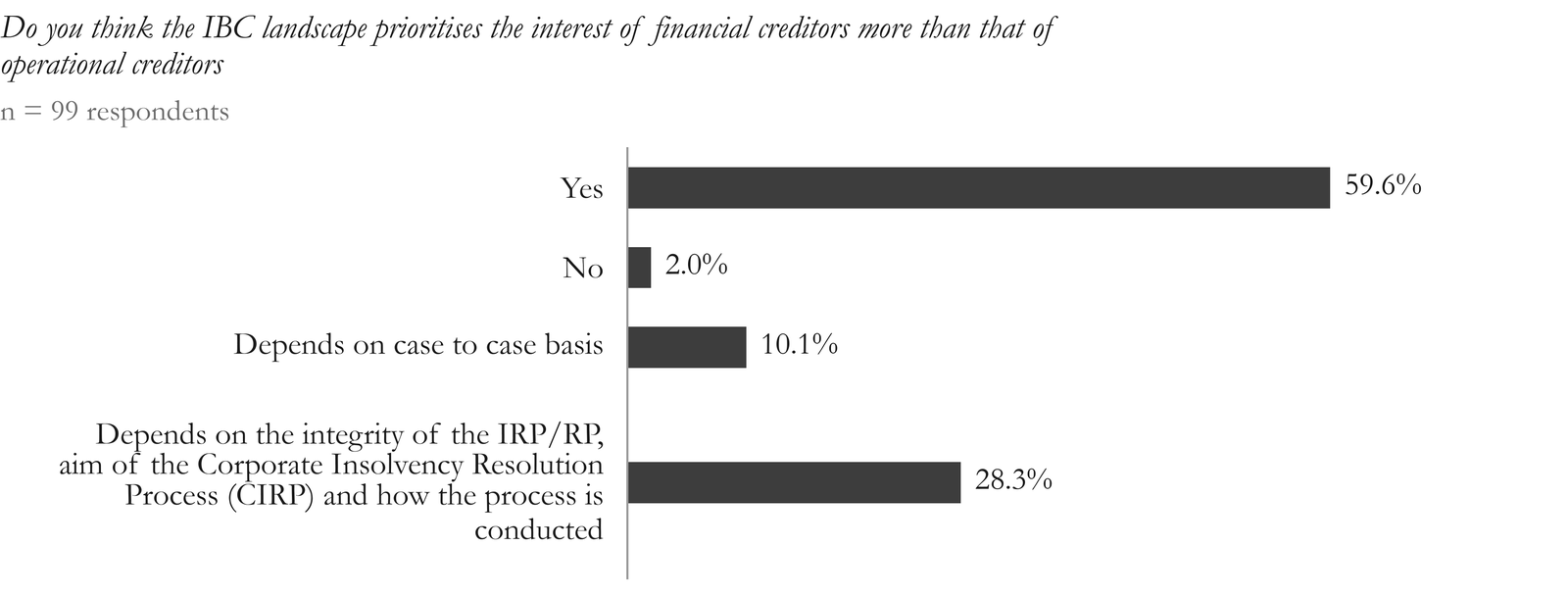
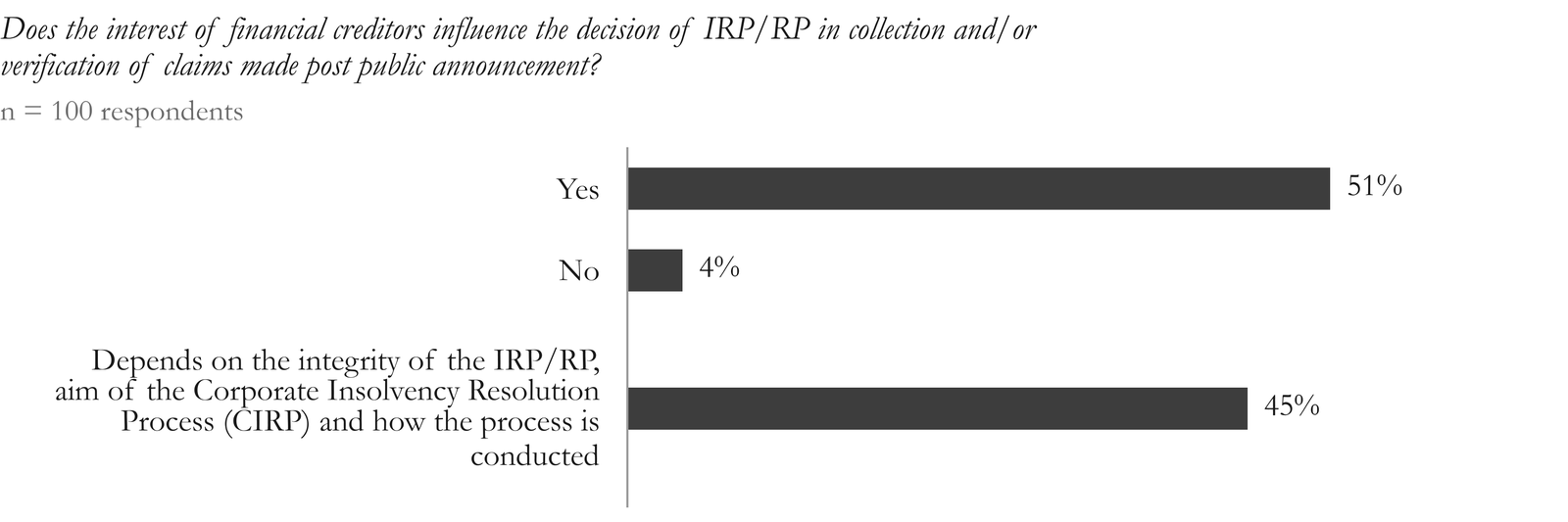
- 2.The survey reveals that 59.6% of respondents (Fig. 4) strongly agree that the Code prioritises the interests of FCs over OCs, while only 2% disagree; the remaining respondents acknowledge the biased functioning of the Code. Additionally, 96% of respondents (Fig. 5) concur that collusion between the RP and FC continues to grow due to the preferential treatment accorded to FCs under the Code.
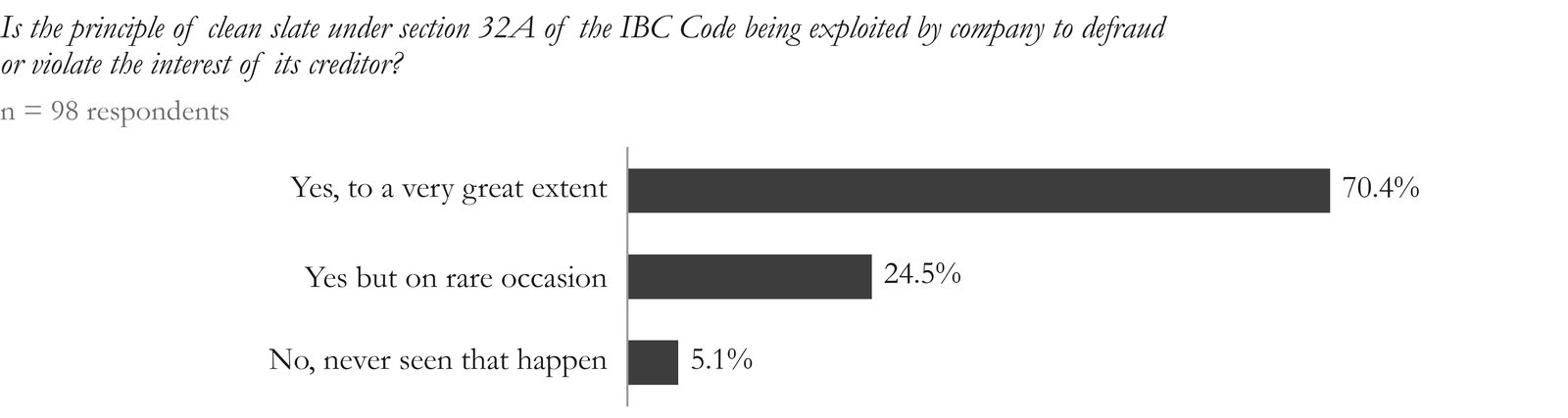
- 3.The survey indicates that 96.8% of respondents (Fig. 7) believe that the CST under Section 32A of the Code is being misused by FCs to the detriment of OCs. FCs allegedly exploit this provision to assume control over the CD’s management post-CIRP, offering minimal returns to OCs through their proposed resolution plans and thereby evading accountability for future claims initiated by OCs.
- 4.The survey reveals that 70.4% of the respondents (Fig. 7) believe that the CST under Section 32A of the Code is being misused by FCs to the detriment of OCs. FCs allegedly exploit this provision to assume control over the CD’s management post-CIRP, offering minimal returns to OCs through their proposed resolution plans to successfully evade accountability for future claims initiated by OCs.
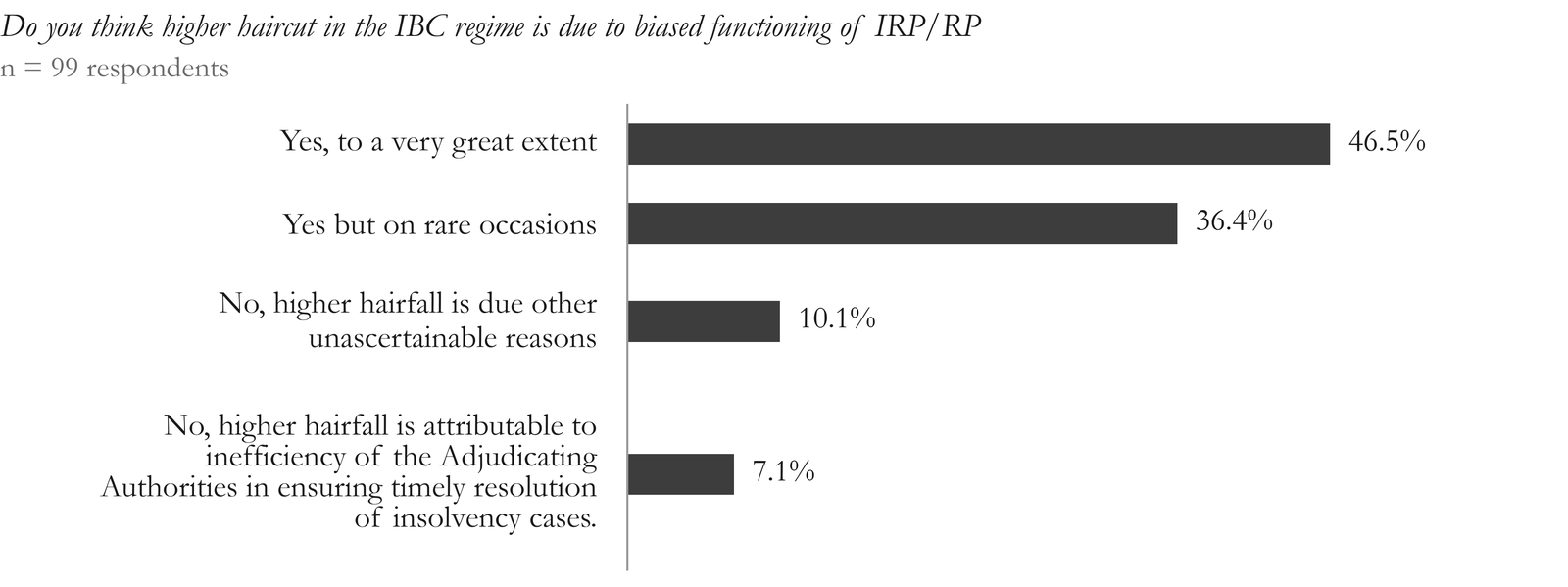
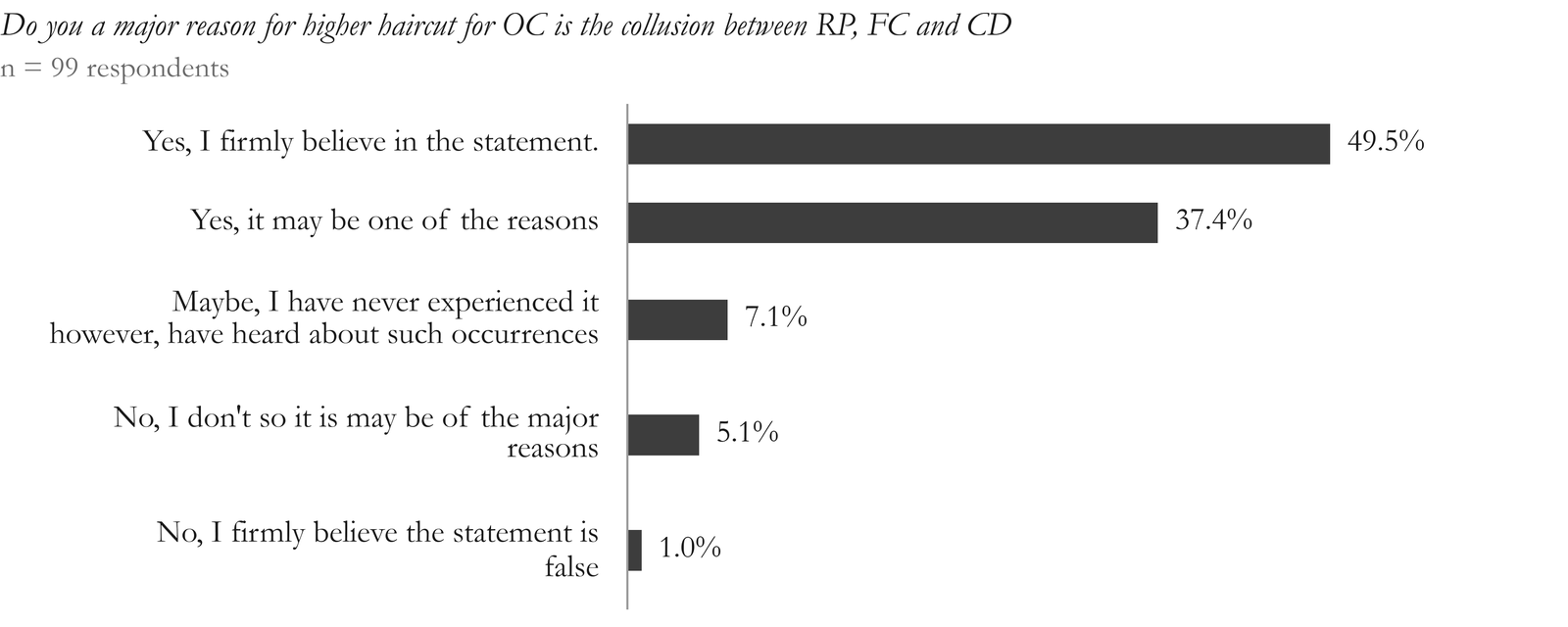
- 5.The survey indicates that 86.9% of respondents (Fig. 8) agree that rising instances of higher haircuts under the Code may be attributed, inter alia, to the biased functioning of the IRP/RP. A minority of 7.7% (Fig. 8) attribute this to inefficiency of the AA. Moreover, 36.4% of respondents (Fig. 9) agree that higher haircuts and biased functioning may also be attributed to collusion between the RP, FC, and CD. While higher haircuts can primarily be attributed to the depreciation in the CD’s asset valuation, another significant factor is the RP’s role in facilitating the approval of suboptimal resolution plans. In several instances, such plans are proposed by FCs who allegedly engage in unfair practices with the RP, resulting in minimal value realisation for OCs.
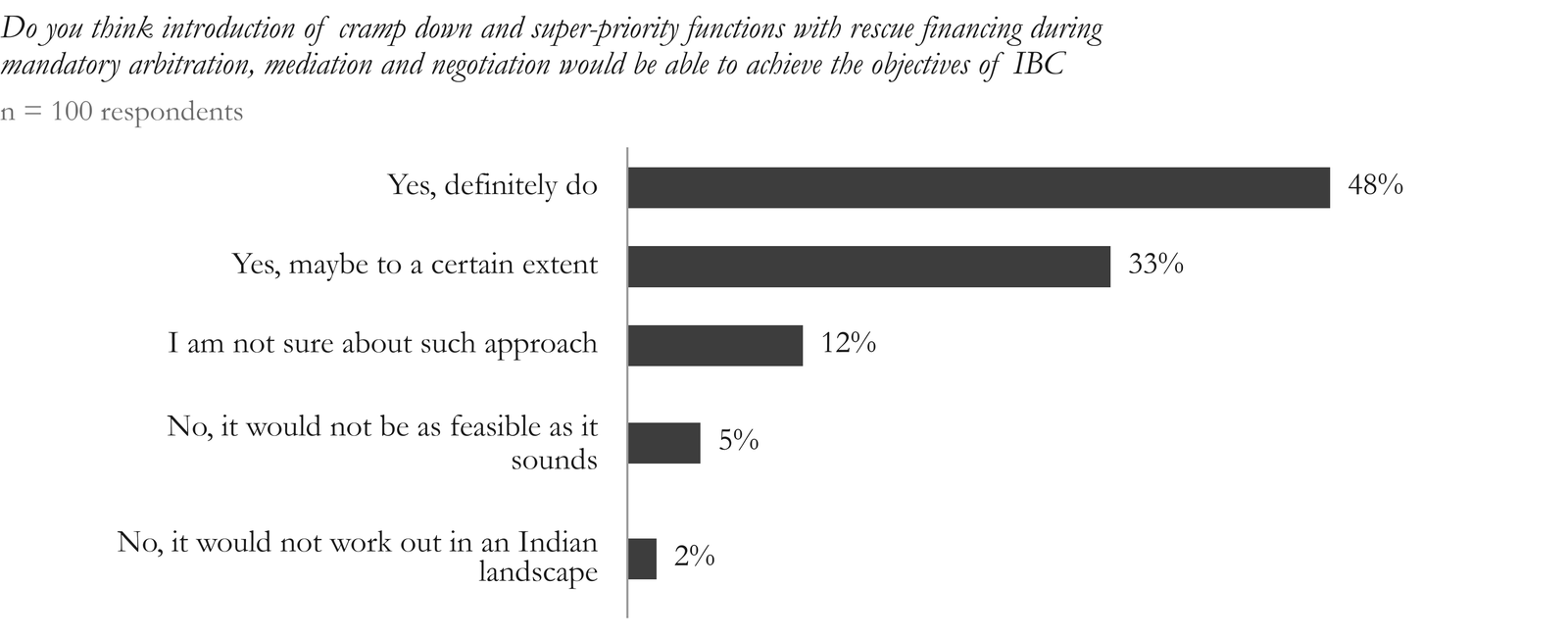
- 6.In furtherance of the loopholes highlighted by the authors—particularly concerning the collusion between RP and FC—the respondents have expressed an overwhelmingly positive response to the proposed solutions.
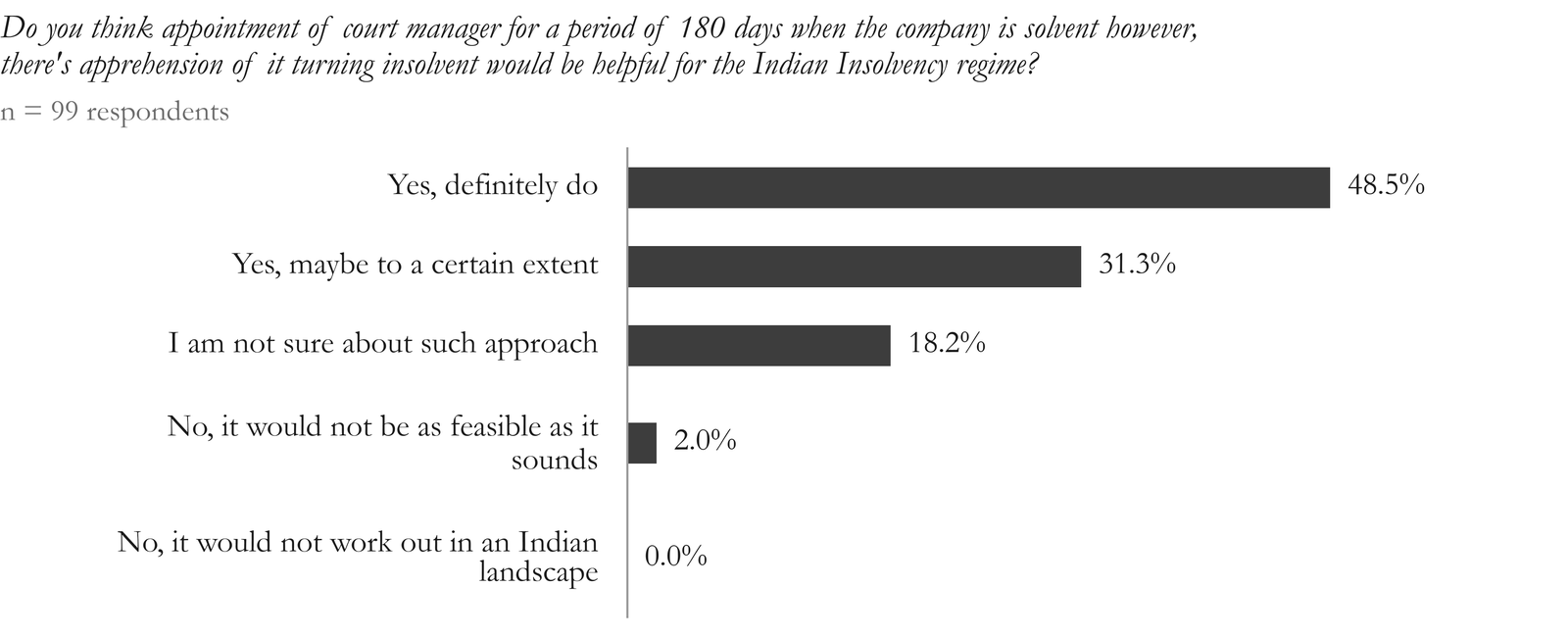
- 7.The survey indicates that 48.5% (Fig. 10) support the appointment of a court-appointed professional for a period of 180 days to aid the CD in continuing as a going concern, especially in cases where the company is solvent but the creditor has a reasonable apprehension that, without financial and managerial support, the CD may enter insolvency.
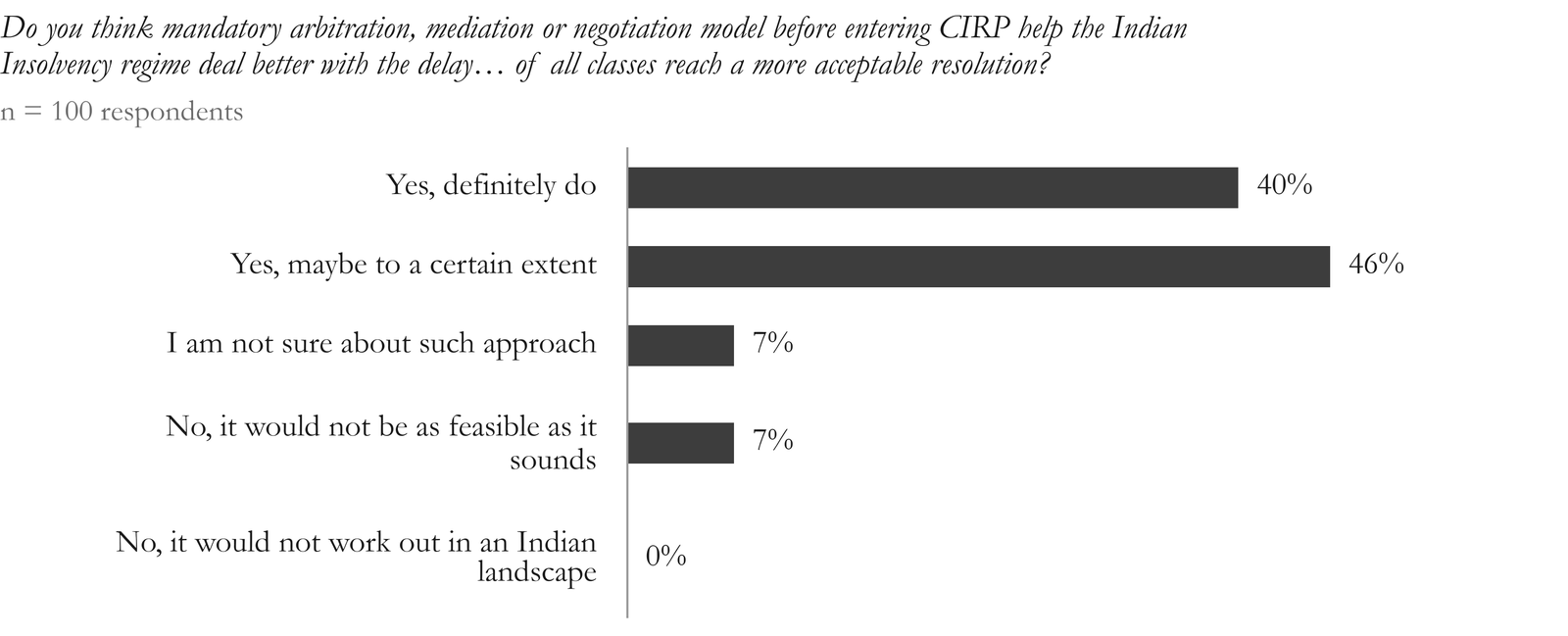
- 8.The survey indicates that 86% of respondents (Fig. 11) concur that pre-insolvency arbitration and mediation may enable OCs to recover their debts more efficiently than during CIRP, while also supporting the CD’s ability to remain a going concern.
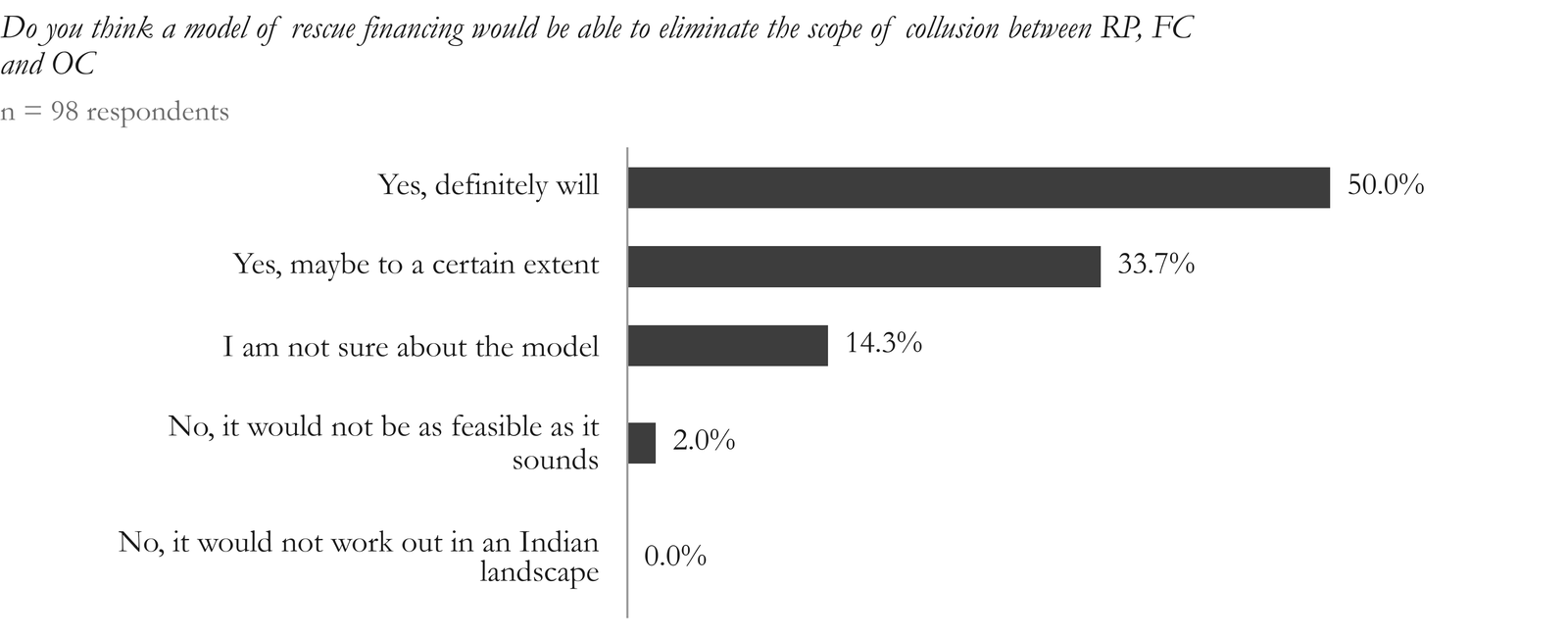
- 9.The survey shows that 88.7% of respondents (Fig. 12) agree that a rescue financing model would help eliminate collusion between the FC, RP, and CD.
- 10.The authors will elaborate on the recommendations outlined in points 7, 8, and 9 in the subsequent “Proposed Solutions” section, along with alternative mechanisms that can be introduced into the Code to safeguard the interests and rights of OCs.
9 Analysis
9.1 Preferential Treatment Accorded to the FC: Creating a Burning Divide?
Under the Code, creditors must constitute a CoC to take material decisions and approve resolution plans under Sections 2123 and 2824. Only financial creditors sit on this committee; operational creditors may attend as observers if their aggregate claims amount to at least ten percent of the total debt, but they have no vote. The committee’s decisions are conclusive: resolution plans affecting both financial and operational creditors are sanctioned on the committee’s economic assessment alone, as provided by Sections 30(3)25 and 30(4)26. In liquidation, Section 5327 prescribes a waterfall mechanism that explicitly prioritises financial creditors; operational creditors are not separately identified and thus rank only within the residual class at the bottom of the priority ladder. This differential treatment has been upheld by the courts28. The 2015 Report of the Bankruptcy Law Reforms Committee29 justified this structure on the grounds that financial creditors have a continuing interest in the debtor’s revival and the capacity to extend further credit, whereas operational creditors seek only to recover their claims. The Supreme Court in Swiss Ribbons30 affirmed that this intelligible distinction promotes efficient capital allocation: repaying financial creditors enables banks and financial institutions to redeploy funds, while operational creditors pursue private debts. Both the UNCITRAL Legislative Guide31 and the World Bank’s 2015 report32 endorse priority of financial over operational creditors as “fundamental to credit efficiency”.
A longstanding concern under the Code has been the differential treatment accorded to its two classes of creditors, FCs and OCs. Unlike many foreign insolvency regimes, the Indian Code adopts a creditor-centric model, purporting both to protect creditor interests and to preserve the CD as a going concern. In practice, however, preferential treatment of FC renders the regime effectively focused on their interests alone. While the Code mandates constitution of a CoC and vests it with exclusive decision-making authority during CIRP under Section 30(4)33, OC are categorically excluded from CoC membership under Section 21(2)34. Consequently, every approved resolution plan accords first priority to FC claims35. OCs have no voting rights, despite the direct impact of CoC decisions on their continued existence and livelihood.
The Code’s stated object is to balance the interests of all stakeholders, yet the dual effect of FC preference and a rising trend of collusion between FC and the RP not only undermines this objective but also infringes the commercial and fundamental rights of OCs36. Such collusive arrangements appear designed to divert liquidation proceeds away from OC in order to satisfy FC claims first, as will be elaborated in the subsequent sections37.
9.1.1 Breach of Code’s Objective for Value Maximisation: Violation of OC’s Fundamental Rights?
The disparity in the treatment of OCs and FCs first came before the Supreme Court in Essar Steel38, which observed that, prior to the 16 August 2019 amendment39, Section 30(2)(b) of the Code40 required that accepted OC claims be satisfied in a manner prescribed by IBBI, i.e., not less than the amount to be paid to OC in the event of liquidation. While the Court reaffirmed that FC claims remain paramount, it emphasised that satisfying OC claims is essential if the CD is to continue as a going concern. Section 53’s41 waterfall mechanism, however, classifies creditor priorities in detail yet remains silent on treatment of OCs, relegating them to the residual bracket of “any remaining debts and dues.” The 2020 Report of the Insolvency Law Committee42 acknowledged this ambiguity and recommended inserting an explanation under Section 53(2)43 to validate inter-creditor and subordination agreements, but this recommendation has not been adopted. Regulation 38 of the CIRP Regulations, 2016 mandates that every resolution plan “conform to the interests of all stakeholders,” including OCs and FCs, yet offers no guidance on how those interests should be balanced or maximised. In Essar Steel, the Court held that OCs and FCs are not entitled to equal recovery, since the principle of equality applies only to similarly situated creditors. Thus, both the Code and successive landmark rulings have repeatedly compromised the interests of OCs.
Nonetheless, OC services are indispensable to the CD, and their stake in the debtor exerts a direct and substantial impact on its survival. The “intelligible differentia” between FCs and OCs, endorsed in Swiss Ribbons44 continues to justify OC subordination in resolution plans. In Binani Industries Ltd.45, allegations of collusion between the RP and FC led to the rejection of five OC claims on the grounds of delayed verification, without any effort to ensure proportionate OC representation under Section 5346. The RP facilitated the approval of various resolution plans by the CoC without adequately addressing the pending claims of OCs. Despite having received the necessary documents, the RP delayed the verification process by repeatedly seeking additional evidence, ultimately excluding the claims from the IM and proceeding with the approval of resolution plans that later led to the extinguishment of OC claims. It is the fundamental duty of the RP to act in a fair and transparent manner to ensure the interests of all stakeholders including OC are duly considered. However, courts have upheld resolution plans wherein the economic interests of OC have been compromised, thereby undermining the sanctity of the Code.
While the authors concur with the principle of intelligible differentia, the differential treatment justified under the Code has led to a situation where the liquidation value accorded to OCs often remains nil, while FCs recover a substantial portion of their dues such as the Binani Industries47, K. Sashidhar48 and Sirpur Paper Mills49 to name a few. This clearly fails to achieve the objective of asset value maximisation of the CD50. The concern is aptly reflected in Essar Steel51, where the Court observed that granting the minimum liquidation value often nil to OCs in the name of balancing stakeholder interests does not, in fact, lead to asset maximisation. This in turn violates the fundamental rights of the OCs under Articles 19(1)(g), 21 and 300A of the Constitution52. The Court placed the responsibility on the CoC to take an unbiased commercial decision that equitably considers OC claims. It was further clarified that mere semantic compliance with Section 30(2)53 is insufficient; rather, the resolution plan must reflect the spirit of the Code, i.e., a genuine attempt to balance the interests of all stakeholders54.
Hence, the core concern that remains is whether Section 3055 of the Code and Regulation 38(1) of the CIRP Regulations, 201656 are in themselves adequate to safeguard the interests of OCs when the RP entrusted with upholding and implementing the objective of these provisions acts in a manner that compromises their claims.
9.2 Instances of Collusion
A common link among following instances is that the IRP or RP, although being an administrative and not a quasi-judicial officer is empowered under Regulation 10 of the CIRP Regulations, 2016, to call for additional evidence from a creditor to substantiate its claim. This means, that, in the absence of a specific list of documents provided in the Code as “evidence”, the RP decides what qualifies as “sufficient evidence”.
This becomes all the more relevant because the claims admitted by the RP are listed in the Information Memorandum (IM) under Section 29 of the Code, which is relied upon by the RAs to formulate resolution plans for the CD’s revival. In the following instances and corresponding precedents, the authors illustrate how RPs misuse their power under Regulation 10 to facilitate discrimination inter-se similarly placed creditors, reclassify creditors, and favour resolution plans that benefit specific FCs:
- (i)Discrimination: In Binani Industries Limited v. Bank of Baroda & Anr., the National Company Law Appellate Tribunal (NCLAT) observed that the CoC wrongly approved the resolution plan submitted by Rajputana Properties, which discriminated among FCs to whom Binani Industries, the CD, was a guarantor and those to whom it was not, while rejecting UltraTech Cement’s higher revised offer for unacceptable reasons, despite the offer having been greenlit by the court.
- (ii)Reclassification: In Rajnish Jain v. BVN Traders & Ors, the NCLAT observed that neither the CoC nor the RP has the power to reclassify a creditor’s status, as both lack adjudicatory powers. The authors argue that this reclassification aimed to concentrate voting rights among certain FCs to approve a plan favouring those FCs.
- (iii)Promotion of Plans: In Independent Sugar Corporation Limited v. Girish Sriram Juneja, while courts did not directly address any aspect of collusion, it was alleged that the RP allowed AGI Greenpac’s resolution plan to be approved by the CoC without prior approval from the Competition Commission of India (CCI), a requirement under Section 31(4) of the Code, while simultaneously indicating to other bidders that such clearance was mandatory.
While Section 60(5)(c) of the Code permits aggrieved creditors to approach the Adjudicating Authority (AA) for relief, by the time AA issues an order, the CIRP proceedings have often concluded. In Greater Noida Industrial Development Authority v. Prabhjit Singh Soni, the Supreme Court (SC) upheld the AA’s decision to recall plan approval to meet the ends of justice. However, recall results in further delays to the CIRP, which already average approximately 582 days, thereby increasing asset depreciation and leading to higher haircuts for creditors. This underscores the insufficiency of existing relief mechanisms and runs contrary to one of the Code’s key objectives, which is, maximizing value of the CD’s assets. Therefore, the RP’s discretion in classifying creditors or determining the nature of their debt must be better regulated under Regulation 13, read with Sections 18(1) and 25(2) of the Code.
9.2.1 Misuse of the Clean Slate Theory (CST)
As per the CST, once a resolution plan is approved, all previous claims not covered in the plan are extinguished, providing clarity and closure. This rule shields resolution applicants from post-resolution liabilities, facilitating uninterrupted operations and avoiding complex litigation. The provision ensures that the successful resolution applicant can run the corporate debtor’s business without being burdened by prior claims or liabilities, thereby avoiding complex, multi-faceted litigation arising from unresolved past claims.
However, Section 29A of the Code places no bar on FCs submitting plans as RAs to gain control over the CD. In some cases, banks have proceeded to acquire the debt-ridden CDs through plans approved by FC-dominated CoCs, often allegedly colluding with RPs to delay the admission of OC claims or favour plans offering higher upfront payment to FCs while imposing massive haircuts on OCs, effectively resulting in negligible or no recovery for them.
These near-zero recoveries are justified using the doctrine of “intelligible differentia”, upheld in Swiss Ribbons v. Union of India (Swiss Ribbons), where the SC recognized that FCs and OCs differ in the nature of debt, financial capacity, and objectives, the revival of the CD and recovery of dues, respectively. In the same year, the SC in CoC of Essar Steel India Limited v. Satish Kumar Gupta & Ors. reiterated that “equality for all” does not mean treating unequally placed creditors alike. A conjoint reading of these precedents suggests that equal or proportionate treatment is not a mandate under the Code, a position that is often invoked to justify denying recovery to OCs.
A textbook example is National Sewing Thread Co. Ltd. v. Superintending Engineer TANGEDCO & Anr., where the promoter group excluded TANGEDCO’s claims from their resolution plan and concealed them from the RP. The Madras High Court observed that CST does not extinguish undisclosed claims, especially when the successful RA is also the promoter, and highlighted the misuse of CST through RP-FC collusion to suppress OC claims.
This practice infringes upon the constitutional right to property under Article 300A, as OCs hold enforceable claims on the CD’s assets, similar to FCs. The disproportionate haircuts imposed on OCs in contrast to significantly higher recoveries for FCs also raise concerns regarding the right to livelihood under Articles 19(1)(g) and Article 21 of the Indian Constitution, particularly since OCs (notably in vendor-centric industries) rely on timely debt repayment to survive.
9.3 Nil Liquidation Value for the OCs: Rising Fear for a Sustainable Livelihood?
Under Section 25,57 it is the statutory duty of the RP to preserve and protect the assets, management, and affairs of the CD. In furtherance of this duty, the RP is required to invite resolution plans from RAs for approval by the CoC. As per Regulation 37B58, the RP must issue an IM, the evaluation matrix, and a request for resolution plans within five days of the issuance of the provisional list, with possible timeline extensions subject to CoC approval. However, given the concentration of decision-making authority in the CoC and the broad powers vested in the RP under the Code, the resolution process is susceptible to manipulation.
This concern materialised in the Binani Industries59, where the RP accepted and submitted a suboptimal resolution plan to the CoC well beyond the stipulated deadline, favouring the interests of FCs at the expense of OCs. The RP is obligated to act fairly, transparently, and in compliance with Section 30(2) of the Code60. However, multiple cases such as Binani Industries61, National Sewing Thread62, Gajendra Verma63, and Dharmindra Kumar64 reflect a repeated pattern wherein the RP has promoted sub-optimal plans and failed to object to resolution plans that do not effectively maximise the CD’s asset value, resulting in inequitable and disproportionate distribution of resolution plan proceeds to OCs, thereby compromising the Code’s core objective of value maximisation65. For instance, in Balaji Minerals66 and Yogeshwar Garg67, the RP failed to contest valuation methods that unjustly allocated negligible or no value to OCs. Similarly, in Byju’s the NCLT found the IRP’s conduct prejudicial to the stakeholders and the CIRP, and in Independent Sugar the Supreme Court held that the RP had no power to relax a statutory precondition to the approval of a resolution plan.6869 This conduct runs contrary to the spirit of the Code and infringes upon the rights of OCs.
While the RP is merely empowered to verify claims and is not conferred with an adjudicatory role, as clarified in Swiss Ribbons70, discriminatory rejection of OC claims, particularly sector-specific exclusions was found to violate the principle of equality. Similarly, in TP Central Odisha Distribution71, the NCLAT, despite upholding the RP’s acceptance of OC claims, reiterated that OC cannot expect parity with FC. Nonetheless, these decisions highlight how the RP’s statutory duty has been repeatedly disregarded, leading to the systemic erosion of OC rights and breach of the Code’s objective of equitable stakeholder treatment and value maximisation.
9.4 Misuse of Information Available with the IRP or RP
In recent developments, a controversy emerged when the CEO of Byju’s publicly alleged, via LinkedIn, that the IRP, EY India and GLAS Trust, one of the FCs, had colluded during the CIRP to undermine the interests of the CD72. The allegations suggest that the IRP attempted to allocate the assets of the CD in a manner that undermined the value of its assets.
Pursuant to Sections 17, 18, 19, 20, and 25 of the Code73, the RP/IRP is entrusted with control over the assets, financial position, management, and affairs of the CD. Additionally, the RP/IRP is granted access to a wide array of financial and operational information, including records from Information Utilities, statutory filings, and reports from professionals such as company secretaries and chartered accountants. With such extensive access, the RP/IRP is uniquely placed to assess the viability and operational prospects of the CD.
Under Section 29,74 the RP is required to prepare an IM in accordance with the format and content specified under Regulation 36(2) of the 2016 Regulations75. However, the scope of the IM is largely retrospective, it is confined to disclosure of present and past data, including assets, liabilities, debts, financial statements, security interests, management details, and the CD’s performance history. It does not mandate disclosure of forward-looking viability assessments—an omission that leaves RAs dependent on case-specific requests for such information, which are further subject to confidentiality undertakings.
In practice, there have been reported instances where the RP/IRP, in alleged collusion with certain FCs, has withheld or selectively disclosed such viability-related information, thereby facilitating the acquisition of high-potential assets by favoured FCs at undervalued prices. This practice was notably highlighted during Binani Industries,76 where concerns were raised regarding the strategic withholding of critical information.
Such deliberate concealment and selective dissemination of material information not only undermine the core principles of the Code—transparency, fairness, and equity—but also expose the system to exploitative practices. The RP/IRP’s failure to act impartially and uphold their statutory duties thereby perpetuates systemic discrimination against other stakeholders, particularly OCs, and exposes fundamental vulnerabilities within the IBC framework.
9.5 A Weak Guarantee for the Independence of RP
The criteria laid down under the Code for adjudicating the independence and impartiality of the IRP and RP primarily focus on their relationship with the CD, rather than with the FCs. Regulation 3 of the 2016 Regulations77 provides that the RP must satisfy two conditions to qualify as independent: (i) the RP must be independent of the CD, and (ii) all directors and partners of the Insolvency Professional Agency of which the RP is a partner or director must also be independent of the CD. The criteria for assessing the independence of the RP from the FC were introduced only in 2018. A reading of Regulation 3(1A)78 read with IBBI Circular No. IP/005/201879 reveals that only limited relationships between the RP and the FCs are brought within the scope of scrutiny, specifically, instances where the RP is a shareholder, director, key managerial personnel, or partner of the FC. However, this framework does not extend to cover other forms of professional and personal associations that may have existed during or prior to the three-year period preceding the RP’s appointment such as advisory, legal, or audit services, or instances where the RP is or was a partner or director of a firm rendering such services to the FC.
Further, the Regulation confines itself to examining the direct relationship between the RP and the concerned FC, while ignoring the RP’s potential relationships with the FC’s associate companies, holding companies, or subsidiaries. This oversight is significant, especially given that indirect associations are expressly recognised under Section 149 of the Companies Act, 201380 when assessing the independence of independent directors.
While the IBBI notification does account for pecuniary relationships between the RP and the FC, such as revenue generated through professional services and shareholding in the FC, it fails to consider potential bias arising from the issuance of debt instruments by the FC to the RP in a personal capacity. Moreover, even if the RP’s shareholding in the FC is negligible, the RP may still possess voting rights, a factor taken into account under foreign regimes such as those in the United States but one that remains unaddressed in the IBBI framework.
Additionally, although the IBBI prescribes a three-year look-back period for assessing such relationships prior to the commencement of the CIRP, it does not contemplate any disqualification of the RP following the conclusion of the CIRP, particularly in situations where the RP may be associated with the successful resolution applicant post-implementation of the resolution plan.
9.6 Causes of Collusion
A core concern in CIRP is the excessive discretion given to the CoC to determine IRP and RP fees and expenses under Regulations 33, 34, 34A and 34B of the CIRP Regulations. This includes both fixed and variable remuneration.
Schedule II, Clause 1 (read with Clause 2) provides that fixed fees depend on the quantum of claims admitted. However, the proviso to Regulation 34B(2) permits the CoC to increase fees based on subjective factors such as process complexity or business scale, creating scope for arbitrary variations with minimal oversight.
Regulation 34A mandates item-wise disclosure of CIRP costs by the RP for approval by the CoC. If not complied with, the CoC can unilaterally fix the fee. Additionally, Regulation 33 allows the applicant, often a FC to fix the initial fee, subject to CoC ratification, presenting a conflict of interest as the same FC later participates in ratifying it.
Further, Regulation 34B(3) and (4) permit performance-linked incentives based on timely resolution and value maximisation. While these are subject to a cap of Rs. 5 crore, the CoC may introduce alternative structures at their discretion.
These fees fall under “insolvency resolution process costs”, which rank highest in the waterfall mechanism under Section 53 of the Code. Hence, arbitrary inflation of IRP/RP fees shrinks the amount available for satisfaction of OC’s claims, which rank far below in priority as compared to resolution costs.
This issue arose in RP of Ariisto Developers Pvt. Ltd. v. The Monitoring Agency nominated by the CoC81, where the RP claimed ₹3 crore as a “success fee” post-approval of the plan—despite it never being disclosed in meetings, the IM, or CIRP cost estimates. The AA deemed the fee unjustified, set it aside, and redirected the amount toward unpaid creditors and employees, underscoring how RPs may align with CoC preferences for higher compensation at the cost of impartiality.
9.7 Impact of Collusion
A fundamental objective of the Code is to balance the interests of all stakeholders. Yet, OCs, largely comprising Micro, Small, and Medium Enterprises (MSMEs) employing 60% of India’s workforce and contributing roughly 29% to the Gross Domestic Product (GDP) have suffered, receiving only a paltry 6% median recovery82. Such low or nil recoveries force vendors to demand advance payments, choking working-capital starved corporates and eroding trust in the Code.
The core issue lies in RPs misusing their discretion under Regulation 10 to reject OC claims and value them at liquidation value. The Supreme Court of India has clarified that liquidation value under Section 30(2)(b) is the minimum, not the maximum, payment OCs are entitled to83. Still, aggrieved creditors excluded from the CoC must wait for the AA to address the RP’s abuse of power before any resolution occurs.
While the resolution-to-liquidation ratio improved marginally from 0.6 in FY to 0.9 in FY25, this gain was offset by delayed timelines, asset depreciation, and record-low liquidation recoveries of 4%84. Worse, once a plan is approved, CST extinguishes all pending claims. Consequently, OCs and even discriminated FCs are turning to alternatives like the Securitisation and Reconstruction of Financial Assets and Enforcement of Security Interest Act, 2002 (SARFAESI Act) and Alternative Dispute Resolution (ADR) mechanisms aggrieved by the prolonged delays and low recovery rates offered by the Code85. The Code is increasingly being used as a “name-drop” to pressure CDs into payment, as evidenced by the 53% withdrawal rate of OC-initiated cases at the pre-admission stage. This trend shows a steep decline in creditors’ faith in the Code.
10 Proposed Solutions
10.1 Pre-Filing Mediation and Arbitration: Most Efficient Alternative for OCs
The Code, under Chapter I, classifies creditors into two categories: FCs and OCs. As explained in Paragraph 5.2.1 of the Bankruptcy Law Reforms Committee Report, FCs are individuals or entities whose relationship with the organization is purely financial—based on a loan or debt instrument, whereas OCs are those whose claims arise from the supply of goods or services. The IBBI86 recently released their discussion paper on Insolvency Mediation87, which appropriately notes that most OC-CD disputes are contractual in nature and can often be resolved without the intervention of the AA through mediation or alternative resolution mechanisms. Unlike FCs, whose interest lies in the restructuring and revival of the CD, OCs are primarily concerned with the recovery of outstanding dues88.
This divergence in interests reflects the Code’s inherent pro-FC orientation. FCs are granted representation on the CoC and enjoy a higher priority in the waterfall mechanism during liquidation. In contrast, OCs have no representation in the CoC and are placed among the residual claimants in liquidation. The 2020 amendment, which increased the default threshold for initiating insolvency proceedings to ₹1 crore, further weakened the position of OCs. Unlike FCs, OCs are not permitted to file joint applications, thereby limiting the remedies available to smaller creditors89.
Given that insolvency resolution is neither the objective nor within the effective control of OCs, their primary focus remains on debt recovery. In this context, pre-litigation mediation or arbitration emerges as a more expedient and efficient mechanism for resolving contractual disputes prior to invoking formal insolvency mechanisms.
10.2 Higher Success Rate for OC on Adopted Alternative Dispute Resolution
Dispute resolution at the pre-admission stage offers significant potential for success, especially for OCs, when compared to later stages of the process. This is largely due to the procedural time lag between the occurrence of default, the filing of the application, and its admission by the AA after hearing both parties. This interim period serves as a crucial opportunity for the OC and CD to initiate meaningful negotiations and attempt an early, amicable settlement of disputes.
As noted in the IBBI discussion paper on Insolvency Mediation, out of the 25,284 applications filed by OCs under Section 990 up to 30 April 2024, only 3,818 were admitted91. Nearly 75% were withdrawn or settled before admission, indicating that OCs are generally more focused on debt recovery than on seeking resolution of the CD. This reinforces the potential of pre-insolvency mediation as an effective tool for OCs to reach a mutually agreeable solution with the CD92.
In light of this, the authors propose a dual-layered alternative dispute resolution framework comprising a hybrid mediation mechanism and a court regulated arbitration process—as a pre-insolvency recourse. The choice between the two modes of ADR should be guided by the nature of the claim and the mutual preference of the OC and the CD, with the AA determining the most appropriate mechanism in each case.
10.3 Pre-Insolvency Mediation Model
The authors, in this paper, propose a model for pre-institution insolvency mediation aimed at identifying financial imbalances at an early stage. Early detection of financial distress is critical in preventing insolvency, and mediation can serve as an effective mechanism for timely intervention. In the first stage, businesses facing temporary financial imbalances (lasting up to 15 days) may voluntarily engage in mediation with their creditors. This voluntary mediation is confidential, enabling the debtor and creditors to explore restructuring options without judicial intervention. Various types of mediation may be employed, such as claims mediation for unliquidated claims, single-creditor mediation for specific disputes, plan mediation to resolve restructuring deadlocks, and group mediation for intra-group claims. All mediation agreements, whether verbal or written, must be recorded within three days to ensure enforceability and legal clarity.
If the financial distress persists beyond 45 days, the second stage—reconstruction mediation—becomes relevant. At this point, the mediation process moves into a more structured, court-assisted framework, ensuring legal oversight and compliance. The mediation panel, which includes a judge, a lawyer with relevant expertise, and a financial consultant, will guide the restructuring process. Options such as debt rescheduling, third-party loans on a super-priority basis, or a combination of these measures can be explored to stabilize the corporate debtor. This stage aims to address temporary financial issues and restore the debtor’s capacity to generate profits, thereby reducing the need for formal insolvency proceedings.
The third stage involves structured mediation, where creditors must submit standard claims outlining the nature of their financial interest. The mediation process then continues with negotiations, where creditors and debtors attempt to reach an agreement on debt restructuring, ensuring that a feasible and executable plan is developed. The process is designed to be time-bound, with a maximum duration of four months and an optional two-month extension under the Commercial Courts Act, 2015, ensuring that mediation does not become a prolonged substitute for insolvency resolution.
In the final stage, a formal restructuring plan (RP) is submitted to the AA for approval. The RP must offer a higher recovery rate than traditional CIRP proceedings and comply with the requirements under Sections 3093 and 3194 of the Code. A mediation panel assists in facilitating creditor negotiations, ensuring that the restructuring plan receives the necessary 66% creditor approval. Once approved by the AA, the mediation settlement becomes binding on all parties. By adopting this four-stage pre-institution mediation model, the insolvency framework can enhance financial stability, reduce the burden on adjudicating authorities, and enable timely interventions that preserve business value and safeguard stakeholder interests.
10.4 Pre-Insolvency Arbitration Model
Apart from mediation, OCs may consider arbitration with the CD to resolve disputes before the admission of the insolvency application under Section 9. In such cases, the OC may submit an application to the AA. Upon receiving this application, the AA must make a prima facie assessment of the arbitrability of the dispute95. If the dispute is deemed arbitrable, the AA shall impose a mandatory moratorium, similar to the one under Section 1496 of the Code. This moratorium may also apply to the CD’s subsidiaries or holding companies, on a case-by-case basis, unlike the current Code, which only imposes a moratorium on the entity facing insolvency.
Since arbitration takes place before the insolvency application is accepted under Section 9, the arbitration proceedings would remain in personam. The AA would govern the proceedings, but the arbitrator can be appointed by the parties in accordance with the Arbitration and Conciliation Act, 1996. The court would first determine whether the dispute is arbitrable by bifurcating the issues into “core” and “non-core” matters97. Core issues involve substantive rights under the Code, such as avoidance provisions i.e., transactions entered to defraud the interests of creditors pre-CIRP therefore, could be reversed, undervalued transactions, transactions intended to defraud creditors, and preferential transactions, which must be adjudicated during the CIRP. Non-core issues, which do not invoke substantive rights under the Code, may be resolved if they fall within the scope of an arbitration agreement.
This approach is commonly adopted in the insolvency regimes of France, Singapore,98 and the United States.99 However, cross-border arbitration, while promoted as an alternative dispute resolution mechanism, does not clearly distinguish between core and non-core issues, creating uncertainty about its application in India due to procedural limitations.
To convince the AA that the disputed claims align with public policy, the OC must demonstrate that the issue is non-core, that arbitration will not result in legal errors, and that arbitration benefits both the OC and the CD. The OC must also show that arbitration is not being used to delay CIRP or liquidation and that it is the most feasible and beneficial alternative. The AA should be particularly vigilant regarding potential abuse of the procedure. If there is doubt about abuse, the presumption should favour arbitration.
Moreover, the AA should assess the objective behind choosing arbitration in insolvency disputes. For instance, arbitration may be preferable if the parties wish to include entities other than the CD or if performance agreements, enforceable only through arbitration, are involved. In such cases, if arbitration serves to provide an adequate remedy for the claimant, it should be supported.
After arbitration is granted by the AA, a market-driven rescue financing model can be implemented. ‘Rescue financing’ (or “DIP financing”) acts as a tool in the restructuring process, where a creditor or third party injects capital to assist in insolvency or restructuring100. Rescue financing can be adopted during arbitration by mutual consent of the CD and the OC or if it is included in the credit agreement between the parties. In cases where third-party rescue financing is implemented, such a party may receive higher priority in payments under Section 53101 during liquidation, depending on the terms agreed upon in the arbitration agreement. However, rescue financing will typically have precedence over unsecured creditors but remain subordinate to secured creditors, granting it what is known as “Super Priority.”102
Section 53103 does not invalidate any contractual agreements made by the CD, including those that give certain debts higher priority, as long as the priority does not apply to equally ranked creditors. To promote rescue financing and prevent corporate entities from entering insolvency, an amendment should be introduced to Section 53104 to include debts owed to a rescue financer alongside debts owed to secured creditors, where the secured creditor has relinquished security as per Section 52105.
Rescue financing may be initiated by the creditor who holds the largest debt owed by the CD, who would then participate in arbitration to assist in the revival of the CD through debt restructuring or rescheduling. Alternatively, it may involve a group of senior creditors, similar to the US system, where senior creditors hold debt with lower risk compared to “junior debt.” Additionally, a third-party, unrelated to the CD, may provide financing and lead the restructuring process. If a rescue financing agreement is already in place between the CD and its creditors, the process would be easier to undertake during insolvency arbitration.
To facilitate rescue financing, an amendment to Section 53106 would be beneficial. The rescue financing plan, once agreed upon by the creditor(s) and the CD, must be approved by the AA, ensuring the plan’s feasibility and effective implementation. Since pre-insolvency arbitration involves the CD and creditor(s), the process remains in personam, providing the OC with a better chance to recover its debt and contribute to the restructuring efforts that support the CD’s continuation as a going concern.
10.5 Power to AA to Refer Dispute for Mediation or Arbitration
Under Section 442 of the Companies Act, 2013107, the NCLT has the power to suo motu refer a dispute to the Mediation and Conciliation Panel maintained by the Central Government. A similar approach could be integrated into the Code, granting the NCLT the authority to suo motu refer insolvency matters to mediation or arbitration at the pre-institution stage, depending on the merits of the case. This provision would allow parties to privately resolve disputes before the admission stage, after which the matter takes on an in rem nature. In addition to promoting voluntary mediation or arbitration, such an amendment would further encourage the use of pre-institution mediation and arbitration. Furthermore, parties who might be disincentivized from pursuing mediation or arbitration for trivial reasons could be mandated by the NCLT, based on the suitability of the dispute for such mechanisms. Ultimately, this recommendation would help alleviate the caseload of the NCLT by limiting its role to referring insolvency disputes for pre-institution mediation.
10.6 Judicial Oversight during Pre-Insolvency Mediation and Arbitration
Judicial oversight is essential to address concerns related to unfair management practices during the restructuring or reconstruction of the CD’s debt, the abuse of power by the rescue financer, and similar issues. However, the role of the AA should be that of an “ultimate arbitrator” rather than merely a “filtering safeguard.” The AA’s responsibility would be to ensure that the arbitration process adheres to due process of law and is conducted in good faith, in the best interest of the parties involved in the arbitration.
10.7 Judicial Management
The Code follows a reactive approach to insolvency, whereas the authors propose adopting a proactive approach. If a corporate entity is unable to pay its debts for 75 days or more, the debtor may apply for a judicial management order from the AA. The objectives of such an order would be: firstly, to continue the company as a going concern; secondly, to facilitate a negotiated arrangement between the company and its creditors; and thirdly, to secure a better outcome for asset realization compared to liquidation. The AA may also issue a judicial management order if deemed in the public interest.
Once the AA grants the judicial management order, a statutory moratorium would automatically apply, preventing creditors from filing insolvency applications. Following the order, control of the company’s operations would transfer to a judicial manager, who would supersede the company’s board of directors. The judicial manager may seek rescue financing plans by issuing an information memorandum for the reconstruction, restructuring, or rescheduling of debts. The judicial manager would have powers similar to those of an IRP/RP under Sections 18108 and 25109 of the Code, and would act on behalf of the company.
Under the supervision of the AA, the judicial manager would be solely responsible for selecting the most viable and efficient rescue financing plan. Rescue financing involves injecting capital to prevent insolvency, and the acceptance of such a plan would solely concern the company, without affecting the rights of other creditors. Therefore, the process would remain a debtor-in-control model, with the management of the company returning to the debtor upon implementation of the rescue financing plan, while the rescue financer would be treated on par with secured creditors under Section 53110.
10.8 Additional Disqualification for IRP/RP
Having addressed the concerns regarding the appointment of the RP, the authors propose incorporating additional disqualifications for the appointment of an IRP/RP. The individual appointed as an RP must be “disinterested,” meaning they should not be a creditor, equity security holder, or insider of the debtor, a criterion widely adopted in the United States insolvency framework.111 The individual must also not possess any financial or personal interest that could impair their capacity to act impartially in the CIRP. Furthermore, the IRP or RP must not maintain any association with the CD that could result in direct or indirect remuneration, revenue generation, or debt facilitation, whether through professional services or otherwise. Moreover, such individuals should not have been previously appointed to any position within the CD, nor should they have served in the capacity of an advisor or employee of the CD. They must also not maintain any form of association with the CD, its creditors, or any stakeholder involved in the CIRP. For the purposes of determining an “associate,” reference should be drawn from the definition provided under Section 79 of the Companies Act, 2013. The disqualification criteria proposed herein are in addition to those laid down under Regulation 3 of the CIRP Regulations, 2016 and the relevant IBBI notifications. The authors further recommend that these additional disqualifications be made applicable for a period of one year following the conclusion of the CIRP, particularly in respect of revenue generated by the RP from professional services. Such restrictions should extend to the RP’s engagements with the CD and also encompass its holding, subsidiary, and associate companies, with the definitions of such entities being adopted as per the Companies Act.
Such disqualification should be for the RP for its work profile with the CD including its holding, subsidiary and associated company, the definition for such companies would be the as provided under the Companies Act, 2013. If any professional is disqualified under these criteria, they must submit an affidavit disclosing their connections with the debtor, creditors, or any other party involved in the insolvency. This framework, which aims to promote the independence of the RP, has been widely adopted in the United States and United Kingdom bankruptcy frameworks.112 A strict adherence to these disqualification standards was seen in the Lehman Brothers case113, where all individuals were required to disclose their affiliations. Similarly, in the In Re Pillowtex, Inc. case114, an advisor to the CD’s board was disqualified from acting as a trustee during liquidation due to prior connections with the debtor. These disqualification standards would be enforceable by the Indian Insolvency Professional Agency (“IPA”).
11 Conclusion
To conclude, while the IBC was envisioned as a robust and transparent mechanism for insolvency resolution, recent judicial developments and industry trends have exposed systemic vulnerabilities—particularly concerning the treatment of OCs. The increasing instances of collusion between RPs, FCs, and CDs not only erode the credibility of the process but also compromise the statutory and constitutional rights of OCs. These issues, far from being incidental, stem from structural gaps within the Code itself—especially the preferential tilt towards FCs, the lack of enforceable checks on RP conduct, and the absence of equitable safeguards for OCs.
There is now an urgent need to reimagine the insolvency regime to restore parity among stakeholders. Drawing from comparative practices in jurisdictions such as the United Kingdom, the United States, and Singapore, solutions such as pre-insolvency mediation, court-supervised rescue financing, and statutory recognition of OC-specific remedies merit serious consideration. Furthermore, amendments to Sections 53115 and 27116, along with stricter qualification norms for RPs, could strengthen institutional integrity.
The evolving jurisprudence on RP–FC–CD collusion has sparked essential discourse, and it is imperative that legal reform follows suit to ensure the Code remains true to its foundational promise of equitable and efficient insolvency resolution.
Notes
Int’l Fin. Corp. & Insolvency and Bankruptcy Board of India, Understanding the IBC: Key Jurisprudence and Practical Considerations: A Handbook (2020), https://ibbi.gov.in/uploads/whatsnew/e42fddce80e99d28b683a7e21c81110e.pdf. ↩
IBBI Research Chair, IBC Brief: Powering with Information, Vol. 1, July–Sept. 2023, Indian Institute of Corporate Affairs (IICA) (2023), https://www.iica.in/ (last visited Mar. 26, 2025) alongside Standing Comm. on Fin., Implementation of Insolvency and Bankruptcy Code – Pitfalls and Solutions, 32d Report (Aug. 3, 2021), https://www.parliamentofindia.nic.in/ (last visited Mar. 26, 2025). ↩
Insolvency and Bankruptcy Code, 2016, § 30. ↩
IBBI Research Chair, IBC Brief: Powering with Information, Vol. 1, July–Sept. 2023, Indian Institute of Corporate Affairs (IICA) (2023), https://www.iica.in/ (last visited Mar. 26, 2025). ↩
Id. ↩
Bankruptcy Law Reforms Comm., The Report of the Bankruptcy Law Reforms Committee, Volume I: Rationale and Design (2015), https://ibbi.gov.in/BLRCReportVol1_04112015.pdf. ↩
Insolvency and Bankruptcy Board of India, Circular No. IP/005/2018 (Jan. 16, 2018), https://ibbi.gov.in/webadmin/pdf/legalframwork/2018/Jan/Disclosures-Circular-12012018(1)-1_2018-01-16182645.pdf. ↩
IBBI (Insolvency Resolution Process for Corporate Persons) Regulations, 2016, reg. 38(1), https://ibbi.gov.in/uploads/legalframwork/2023-10-04-212254-qxy5-9c59d1599fc4604c5f9b220bc26e4f93.pdf. ↩
Nat’l Sewing Thread Co. v. Superintending Eng’r, TANGEDCO, W.P. No. 29845 of 2022 (Madras HC June 7, 2024). ↩
The Insolvency and Bankruptcy Code, 2016, § 7. ↩
Id. § 240A. ↩
Id. § 32A. ↩
Id. § 30(4). ↩
Id. § 31. ↩
Id. § 30(2)(b), explanation 1. ↩
Id. § 53. ↩
India Const. art. 300A. ↩
The Insolvency and Bankruptcy Code, 2016, § 18. ↩
Id. § 32A. ↩
2025 INSC 124. ↩
The Competition Act, 2002, § 5. ↩
GLAS Tr. Co. LLC v. BYJU Raveendran, I.A. Nos. 835, 840, 940 of 2024, I.A. Nos. 177, 178 & 179 of 2024 in C.P. (IB) No. 149/BB/2023 (NCLT Bengaluru Feb. 24, 2025). ↩
Insolvency and Bankruptcy Code, 2016, § 21. ↩
Id. § 28. ↩
Id. § 30(3). ↩
Id. § 30(4). ↩
Id. § 53. ↩
Swiss Ribbons Pvt. Ltd. v. Union of India, (2019) 4 SCC 17 read with Rajputana Props. Pvt. Ltd. v. UltraTech Cement Ltd., Company Appeal (AT) (Insolvency) No. 188 of 2018 (NCLAT July 19, 2018). ↩
Ministry of Fin., Gov’t of India, The Report of the Bankruptcy Law Reforms Committee, Volume I: Rationale and Design (Nov. 2015), https://ibbi.gov.in/BLRCReportVol1_04112015.pdf. ↩
Swiss Ribbons Pvt. Ltd. v. Union of India, (2019) 4 SCC 17. ↩
United Nations Comm’n on Int’l Trade Law (UNCITRAL), Legislative Guide on Insolvency Law (2005), https://uncitral.un.org/en/texts/insolvency/legislative-guides/insolvency-law. ↩
World Bank, Report on the Treatment of the Insolvency of Natural Persons (2015), https://documents.worldbank.org/en/publication/documents-reports/documentdetail/826061467086349622/report-on-the-treatment-of-the-insolvency-of-natural-persons. ↩
Insolvency and Bankruptcy Code, 2016, § 30(4). ↩
Id. § 21(2). ↩
Swati Singh, Distinction b/w Operational & Financial Creditors & Position of the Former in View of Swiss Ribbons, Indian Review of Corporate and Commercial Laws (June 25, 2019), https://www.irccl.in/post/distinction-b-w-operational-financial-creditors-position-of-the-former-in-view-of-swiss-ribbons. ↩
Nat’l Sewing Thread Co. v. Superintending Eng’r, TANGEDCO, W.P. No. 29845 of 2022 (Madras HC June 7, 2024). ↩
Nat’l Sewing Thread Co. v. Superintending Eng’r, TANGEDCO, W.P. No. 29845 of 2022 (Madras HC June 7, 2024) read with Aditya Birla Fin. Ltd. v. Pankaj Srivastava, IA Nos. 660, 820 of 2024 in C.P. (IB) No. 149/BB/2023 (NCLT Bengaluru Jan. 29, 2025) read with Gajendra Verma v. State of Madhya Pradesh, MCRC No. 2535 of 2019 (Feb. 1, 2019). ↩
Comm. of Creditors of Essar Steel India Ltd. v. Satish Kumar Gupta, (2020) 8 SCC 531. ↩
The Insolvency and Bankruptcy Code (Amendment) Act, 2019. ↩
Insolvency and Bankruptcy Code, 2016, § 30(2)(b). ↩
Id. § 53. ↩
Insolvency Law Comm., Ministry of Corp. Aff., Gov’t of India, Report of the Insolvency Law Committee (Feb. 2020), https://ibbi.gov.in/uploads/resources/2020-02-20-ILC-Report.pdf. ↩
Insolvency and Bankruptcy Code, 2016, § 53(2). ↩
Swiss Ribbons Pvt. Ltd. v. Union of India, (2019) 4 SCC 17. ↩
Binani Indus. Ltd. v. Bank of Baroda, Company Appeal (AT) (Insolvency) No. 82 of 2018 (NCLAT). ↩
Insolvency and Bankruptcy Code, 2016, § 53. ↩
Binani Indus. Ltd. v. Bank of Baroda, Company Appeal (AT) (Insolvency) No. 82 of 2018 (NCLAT). ↩
K. Sashidhar v. Indian Overseas Bank, (2019) 12 SCC 150. ↩
Central Bank of India v. Resolution Professional of the Sirpur Paper Mills Ltd., Company Appeal (AT) (Insolvency) No. 526 of 2018 (NCLAT). ↩
Swati Singh, Distinction b/w Operational & Financial Creditors & Position of the Former in View of Swiss Ribbons, Indian Review of Corporate and Commercial Laws (June 25, 2019), https://www.irccl.in/post/distinction-b-w-operational-financial-creditors-position-of-the-former-in-view-of-swiss-ribbons. ↩
Comm. of Creditors of Essar Steel India Ltd. v. Satish Kumar Gupta, (2020) 8 SCC 531. ↩
Nat’l Sewing Thread Co. v. Superintending Eng’r, TANGEDCO, W.P. No. 29845 of 2022 & W.M.P. No. 29233 of 2022, 2024 SCC OnLine Mad 2330 (Madras HC June 7, 2024). ↩
Insolvency and Bankruptcy Code, 2016, § 30(2)(b). ↩
Swati Singh, Distinction b/w Operational & Financial Creditors & Position of the Former in View of Swiss Ribbons, Indian Review of Corporate and Commercial Laws (June 25, 2019), https://www.irccl.in/post/distinction-b-w-operational-financial-creditors-position-of-the-former-in-view-of-swiss-ribbons. ↩
Insolvency and Bankruptcy Code, 2016, § 30. ↩
Insolvency and Bankruptcy Board of India (Insolvency Resolution Process for Corporate Persons) Regulations, 2016, reg. 38(1). ↩
Insolvency and Bankruptcy Code, 2016, § 25. ↩
Insolvency and Bankruptcy Board of India (Insolvency Resolution Process for Corporate Persons) Regulations, 2016, reg. 37B. ↩
Binani Indus. Ltd. v. Bank of Baroda, Company Appeal (AT) (Insolvency) No. 82 of 2018 (NCLAT). ↩
Insolvency and Bankruptcy Code, 2016, § 30(2). ↩
Binani Indus. Ltd. v. Bank of Baroda, Company Appeal (AT) (Insolvency) No. 82 of 2018 (NCLAT). ↩
Nat’l Sewing Thread Co. v. Superintending Eng’r, TANGEDCO, W.P. No. 29845 of 2022 (Madras HC June 7, 2024). ↩
Civil Appeal No. 1234 of 2021 (SC Mar. 15, 2021). ↩
Dharmindra Constrs. Pvt. Ltd. v. Rajendra Kumar Jain, Resolution Professional of Kudos Chemie Ltd., Company Appeal (AT) (Insolvency) No. 1477 of 2022 (NCLAT Jan. 18, 2023). ↩
Swati Singh, Distinction b/w Operational & Financial Creditors & Position of the Former in View of Swiss Ribbons, Indian Review of Corporate and Commercial Laws (June 25, 2019), https://www.irccl.in/post/distinction-b-w-operational-financial-creditors-position-of-the-former-in-view-of-swiss-ribbons. ↩
Balaji Minerals v. Essar Power M.P. Ltd., Company Appeal (AT) (Insolvency) No. 1083 of 2021 (NCLAT Apr. 29, 2024). ↩
Yogeshwar Garg v. Mandeep Gujral, RP, Jaycon Infrastructure Ltd., Company Appeal (AT) (Insolvency) No. 1481 of 2023 (NCLAT Dec. 18, 2023). ↩
Bd. of Control for Cricket in India v. Think & Learn Pvt. Ltd., C.P. (IB) No. 149/BB/2023 (NCLT Bengaluru Mar. 20, 2025). ↩
Indep. Sugar Corp. v. Girish Sriram Juneja, 2025 INSC 124. ↩
Swiss Ribbons Pvt. Ltd. v. Union of India, (2019) 4 SCC 17. ↩
TP Central Odisha Distrib. Ltd. v. COS Bd. Indus. Ltd., Company Appeal (AT) (Insolvency) No. 613 of 2022 (NCLAT July 4, 2023). ↩
Byju Alleges Collusion in Insolvency Proceedings Amid Whistleblower Claims, Times of India (Mar. 1, 2025), https://timesofindia.indiatimes.com/business/india-business/byju-alleges-collusion-in-insolvency-proceedings-amid-whistleblower-claims/articleshow/118648513.cms. ↩
Insolvency and Bankruptcy Code, 2016, §§ 17, 18, 19, 20, 25. ↩
Id. § 29. ↩
Insolvency and Bankruptcy Board of India (Insolvency Resolution Process for Corporate Persons) Regulations, 2016, reg. 36(2), Gazette of India, pt. III sec. 4 (Nov. 30, 2016). ↩
Binani Indus. Ltd. v. Bank of Baroda, Company Appeal (AT) (Insolvency) No. 82 of 2018 (NCLAT Nov. 14, 2018). ↩
Insolvency and Bankruptcy Board of India (Insolvency Resolution Process for Corporate Persons) Regulations, 2016, reg. 3, Gazette of India, pt. III sec. 4 (Nov. 30, 2016). ↩
Id. reg. 3(1A). ↩
Insolvency and Bankruptcy Board of India, Circular No. IP/005/2018, Disclosures by Insolvency Professionals and Other Professionals Appointed by Insolvency Professionals Conducting Resolution Processes (Jan. 16, 2018), https://ibbi.gov.in/webadmin/pdf/legalframwork/2018/Jan/Disclosures-Circular-12012018(1)-1_2018-01-16182645.pdf. ↩
Companies Act, 2013, § 149. ↩
Jayesh N. Sanghrajka v. Monitoring Agency Nominated by the Comm. of Creditors of Ariisto Developers Pvt. Ltd., Company Appeal (AT) (Insolvency) No. 392 of 2021 (NCLAT Sept. 20, 2021), https://ibbi.gov.in/uploads/order/6022af803a1c250beb393e0d10fc4e25.pdf. ↩
NITI Aayog, NITI Aayog Releases Report on “Designing a Policy for Medium Enterprises”, Press Information Bureau (May 26, 2025), https://www.pib.gov.in/PressReleasePage.aspx?PRID=2131261. ↩
Gail India Ltd. v. Ajay Joshi, Company Appeal (AT) (Insolvency) No. 492 of 2019 (NCLAT Oct. 4, 2021), https://ibbi.gov.in/uploads/order/fa8460fefa8cd158bd36a501344344e4.pdf. ↩
Insolvency & Bankruptcy Bd. of India, Report of the Working Group on Group Insolvency (Sept. 23, 2019), https://ibbi.gov.in/uploads/resources/d2b41342411e65d9558a8c0d8bb6c666.pdf. ↩
The Enforcement of Security Interest and Recovery of Debts Laws and Miscellaneous Provisions (Amendment) Act, 2016, https://www.drtcbe.tn.nic.in/Actsrules/SARFAESI%20AMENDMENT%20ACT%202016.pdf. ↩
Bankruptcy Law Reforms Comm., The Report of the Bankruptcy Law Reforms Committee, Volume I: Rationale and Design (Nov. 2015), https://ibbi.gov.in/BLRCReportVol1_04112015.pdf. ↩
Insolvency & Bankr. Bd. of India, Discussion Paper on Mediation by the Operational Creditors (OCs) Before Approaching Adjudicating Authority (AA) for Filing Section 9 Application (Nov. 4, 2024), https://ibbi.gov.in/uploads/whatsnew/5432fd4873e30cdb2e4ab4802454565c.pdf. ↩
Id. ↩
Bankruptcy Law Reforms Comm., The Report of the Bankruptcy Law Reforms Committee, Volume I: Rationale and Design (Nov. 2015), https://ibbi.gov.in/BLRCReportVol1_04112015.pdf. ↩
The Insolvency and Bankruptcy Code, 2016, § 9. ↩
Insolvency & Bankr. Bd. of India, Discussion Paper on Mediation by the Operational Creditors (OCs) Before Approaching Adjudicating Authority (AA) for Filing Section 9 Application (Nov. 4, 2024), https://ibbi.gov.in/uploads/whatsnew/5432fd4873e30cdb2e4ab4802454565c.pdf. ↩
Id. ↩
The Insolvency and Bankruptcy Code, 2016, § 30. ↩
Id. § 31. ↩
Centre for Arbitration and Mediation Studies, SICA Conference on Arbitration & Dispute Resolution, YouTube (Oct. 17, 2023), https://youtu.be/6tj-IwJA6T8?si=hEptuhq9GIDPXy-x. ↩
The Insolvency and Bankruptcy Code, 2016, § 14. ↩
ICLG – International Arbitration Laws and Regulations, USA, International Comparative Legal Guides (2024), https://iclg.com/practice-areas/international-arbitration-laws-and-regulations/usa (last visited Mar. 26, 2025). ↩
Centre for Arbitration and Mediation Studies, SICA Conference on Arbitration & Dispute Resolution, YouTube (Oct. 17, 2023), https://youtu.be/6tj-IwJA6T8?si=hEptuhq9GIDPXy-x. ↩
ICLG – International Arbitration Laws and Regulations, USA, International Comparative Legal Guides (Sept. 13, 2024), https://iclg.com/practice-areas/international-arbitration-laws-and-regulations/usa. ↩
Lydia Tsioli, Rescue Financing Under a ‘Viability Spotlight’, 22 J. Corp. L. Stud. 843 (2023), published online Jan. 11, 2023. ↩
The Insolvency and Bankruptcy Code, 2016, § 53. ↩
Id. ↩
Id. ↩
Id. ↩
Id. § 52. ↩
Id. § 53. ↩
The Companies Act, 2013, § 442. ↩
The Insolvency and Bankruptcy Code, 2016, § 18. ↩
Id. § 25. ↩
Id. § 53. ↩
11 U.S.C. § 327 (2018) read with ICLG – International Arbitration Laws and Regulations, USA, International Comparative Legal Guides (2024), https://iclg.com/practice-areas/international-arbitration-laws-and-regulations/usa (last visited Mar. 26, 2025) read with Centre for Arbitration and Mediation Studies, SICA Conference on Arbitration & Dispute Resolution, YouTube (Oct. 17, 2023), https://youtu.be/6tj-IwJA6T8?si=hEptuhq9GIDPXy-x. ↩
Insolvency Practitioners Ass’n, Code of Ethics (2020), https://www.ipa.uk.com; Institute of Chartered Accountants in England and Wales, Ethical Standards (2020), https://www.icaew.com. ↩
Lehman Bros. Holdings Inc. v. Joint Administrators of Lehman Bros. Int’l (Eur.), [2017] UKSC 38. ↩
349 F.3d 711 (2003). ↩
The Insolvency and Bankruptcy Code, 2016, § 53. ↩
Id. § 27. ↩
Cite this chapter
Rights and permissions
Open accessThis chapter is published under the Creative Commons Attribution-NonCommercial 4.0 International licence, which permits use and sharing with appropriate credit to the authors and the source, within the terms of that licence.